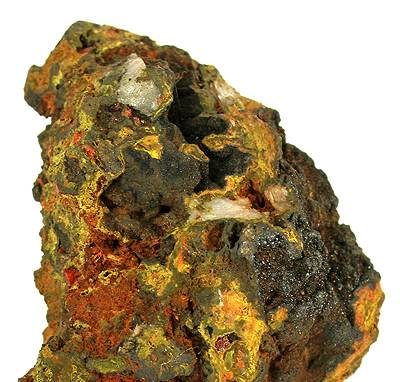
Embreyite , Vauquelinite Locality: Berezovskoe Au Deposit (Berezovsk Mines), Berezovskii (Berezovskii Zavod) , Ekaterinburg (Sverdlovsk) , Ekaterinburgskaya (Sverdlovskaya) Oblast', Middle Urals, Urals Region, Russia ( Locality at mindat.org ) Size: small cabinet, 7.7 x 4.9 x 4.0 cm Vauquelinite with Embreyite A very rich specimen from this famous lead deposit, with rich postachio-green Vauquelinite microxls all over the piece, and minute druses of embreyite microxls as well (they are orange, and seem intermixed quite liberally on the righthand side) . The even rarer cassedanneite is red and although I have not analysed the red micros here, it is possible they are that species. Type Locality for both species! — Photo: Robert M. Lavinsky · CC BY-SA 3.0
Embreyite
Embreyite is an IMA-recognized mineral species in the phosphate class, with the chemical formula Pb₅(CrO₄)₂(PO₄)₂·H₂O.
It crystallizes in the monoclinic crystal system (space group P2_1/m).
Key properties: Mohs hardness 3.5; specific gravity 6.45; Yellow streak; Vitreous, resinous, dull luster; optically biaxial.
IMA symbol Emb, IMA status: approved, named in 1971.
On museum samples from the oxidized zone of gold-bearing quartz veins (Beresovsk, Russia).
It is found associated with Crocoite, phoenicochroite, vauquelinite, cassedanneite, cerussite (Beresovsk, Russia); crocoite, vauquelinite, fornacite, pyromorphite, mimetite.
The mineral was named to honor Peter Godwin Embrey (1929–), English mineralogist, British Museum (Natural History), London, England.