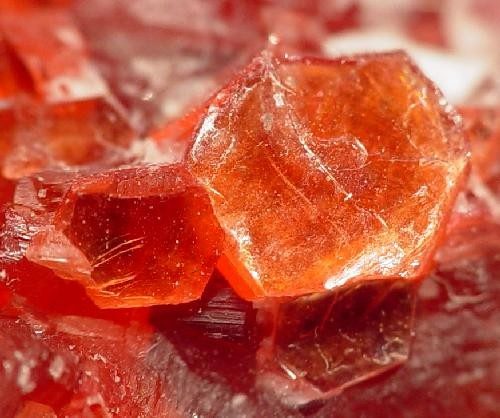
Ephesite Locality: Wessels Mine (Wessel's Mine), Hotazel, Kalahari manganese fields, Northern Cape Province , South Africa ( Locality at mindat.org ) Size: 3.3 x 3.2 x 3.2 cm. Beautiful and lustrous (vitreous to pearly) crystals of the very rare PINK mica, Ephesite. This specimen, from the famous Wessels Mine, has both books (up to 3 mm across!) showing the classic hexagonal cross-section of mica, and elongated crystals (in reality, complete books) also about 3 mm long. The color is so rich on these Ephesites that is actually goes beyond the classic pink into an amazing metallic red, with just a hint of orange for interest. — Photo: Robert M. Lavinsky · CC BY-SA 3.0
Ephesite
A rare lithium mica restricted to quartz-free, alumina-rich rocks, found in South Africa's Postmasburg district and at Ephesus, Turkey.
Intro adapted from Wikipedia (CC BY-SA).
Ephesite is an IMA-recognized mineral species in the silicate class, with the chemical formula NaLiAl₂(Si₂Al₂)O₁₀(OH)₂.
It crystallizes in the triclinic crystal system (space group C1). It is a member of the Mica structural group.
Key properties: Mohs hardness 3.5–4; specific gravity 2.984; Vitreous, pearly on cleavage luster; refractive index 1.615; optically biaxial.
IMA symbol Eph, IMA status: approved, named in 1851.
Found in an emery deposit (Gumuch-dagh, Turkey); a minor constituent in manganese oxide ore (Postmasburg district, South Africa).
It is found associated with Corundum, magnetite (Gumuch-dagh, Turkey); diaspore, braunite, bixbyite (Postmasburg district, South Africa).
The name refers to Ephesus, Turkey, near where it may occur.