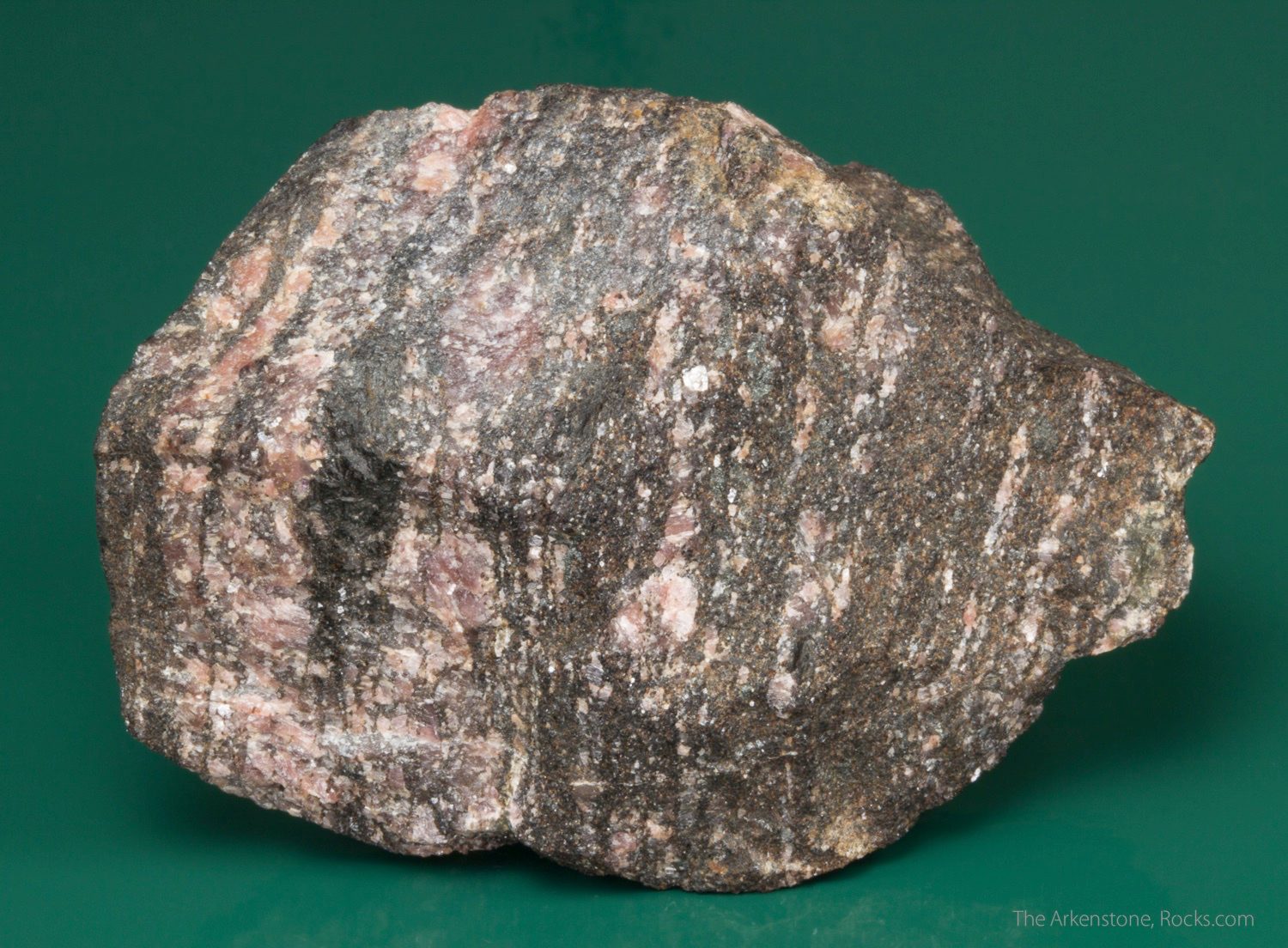
5.5 x 4.5 x 2.5 cm. Granular massive, red-brown ericssonite and ericssonite-2O (orthoericssonite - barium manganese iron silicates) along with manganoan aegirine are transected by dark pink veinlets composed prismatic aggregates of rhodonite. A classic example of the banded tephroite-rhodonite-manganoan aegirine skarn zone from Langban, Filipstad, Varmland, Sweden the type locality for the two featured species. We're using the long-standing terminology of these two minerals here rather than the currently debated 2M and 2O polytype nomenclature. Ex. Paulo Matioli collection and also has Trinity Mineral Company label. — Photo: Robert M. Lavinsky · CC BY-SA 3.0
Ericssonite
A barium-manganese-iron sorosilicate named for John Ericsson, the engineer behind the ironclad USS Monitor.
Intro adapted from Wikipedia (CC BY-SA).
Ericssonite is an IMA-recognized mineral species in the silicate class, with the chemical formula BaMn²⁺₂Fe³⁺(Si₂O₇)O(OH).
It crystallizes in the orthorhombic crystal system (space group C2/m). It is a member of the Ericssonite structural group.
Key properties: Mohs hardness 4.5; specific gravity 4.21; Rich brown streak; refractive index 1.847; optically biaxial.
IMA symbol Ers, IMA status: approved, named in 1966.
A rare mineral, embedded in a fine-grained manganoan aegirine zone in well-banded tephroite-rhodonite-manganoan aegirine skarn, in a metamorphosed Fe{Mn orebody.
It is found associated with Orthoericssonite, tephroite, rhodonite, manganoan aegirine, hedyphane, andradite, hausmannite, lº angbanite, richterite.
In honor of John E. Ericsson (1803–1889), Swedish-American inventor and designer of the iron-clad ship \Monitor, " who was born at Lº angban, Sweden.