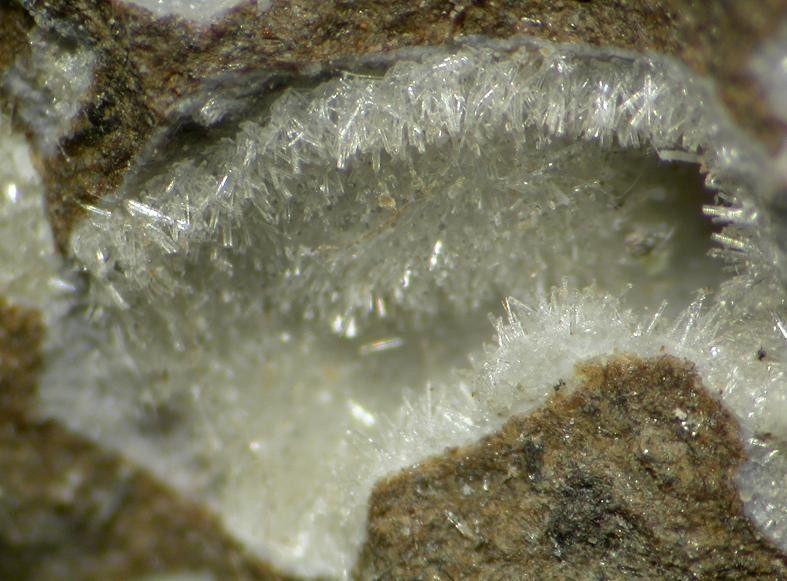
Erionite-K Locality: Chase Creek, Falkland, Kamloops Mining Division, British Columbia, Canada Acicular xls of Erionite-K (analysed). Field of view 7 mm. Specimen and photo Leon Hupperichs. — Photo: Leon Hupperichs · CC BY-SA 3.0
Erionite-K
Erionite is a naturally occurring asbestiform mineral that belongs to a group of minerals called zeolites. It usually is found in volcanic ash that has been altered by weathering and ground water. Erionite forms brittle, wool-like fibrous masses in the hollows of rock formations and has an internal molecular structure similar to chabazite. This mineral is likely as toxic as blue asbestos; however, erionite is not currently regulated by the U.S. Environmental Protection Agency and there are no occupational exposure limits for this substance. Erionite was first described by A.S.
Intro adapted from Wikipedia (CC BY-SA).
Erionite-K is an IMA-recognized mineral species in the silicate class, with the chemical formula K₁₀[Si₂₆Al₁₀O₇₂]·30H₂O.
It crystallizes in the hexagonal crystal system (space group P6_3/mmc). It is a member of the Erionite structural group.
Key properties: Mohs hardness 3.5–4; specific gravity 2.08; White streak; Vitreous to silky luster; optically uniaxial.
IMA symbol Eri-K, IMA status: approved, named in 1964.
Found in basalts; in altered rhyolitic tuffs and lake-bed sediments produced through alteration of vitric ash fallen into the lakes.
It is found associated with Zeolites, \opal, " quartz, celadonite, montmorillonite, dolomite, calcite.
The name refers to the Greek word for wool, recalling its common appearance.