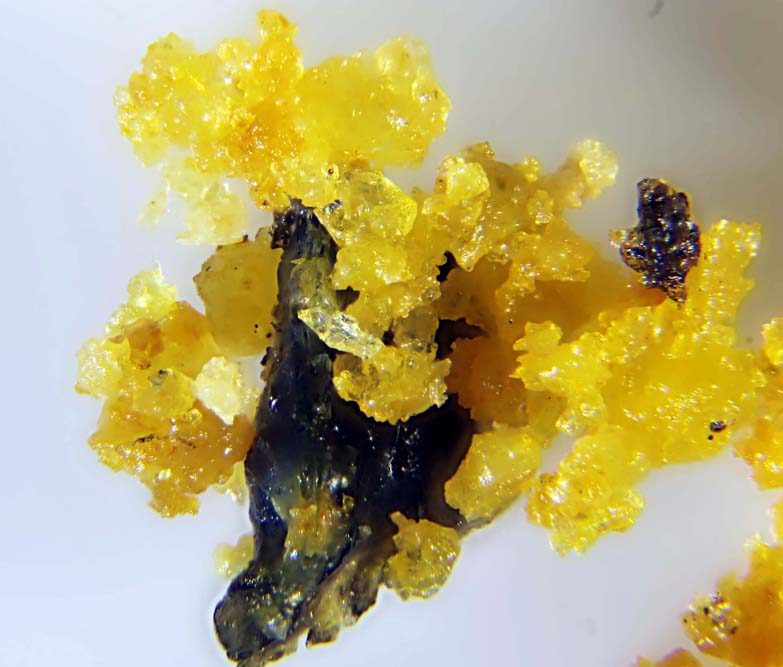
Yellowish orange crystals of the rare mineral erythrosiderite from the type locality in Vesuvius (Monte Somma, Vesuvius, Campania, Italy) and only one the very few localities known worldwide. — Photo: David Hospital · CC BY-SA 4.0
Erythrosiderite
Erythrosiderite is an IMA-recognized mineral species in the halide class, with the chemical formula K₂Fe³⁺Cl₅·H₂O.
It crystallizes in the orthorhombic crystal system (space group Pnma).
Key properties: specific gravity 2.364; Vitreous luster; optically biaxial.
IMA symbol Esd, grandfathered status — known before the IMA’s founding, named in 1872.
Occurs as sublimates around fumaroles (Vesuvius, Italy); rimming rinneite in bedded salt deposits (Stassfurt, Germany; Kansk-Taseev depression, Russia).
It is found associated with Kremersite, molysite, hematite (Vesuvius, Italy); rinneite (Stassfurt, Germany; Kansk-Taseev depression, Russia).
Its name comes from the Greek for red and iron, in allusion to its color and composition.