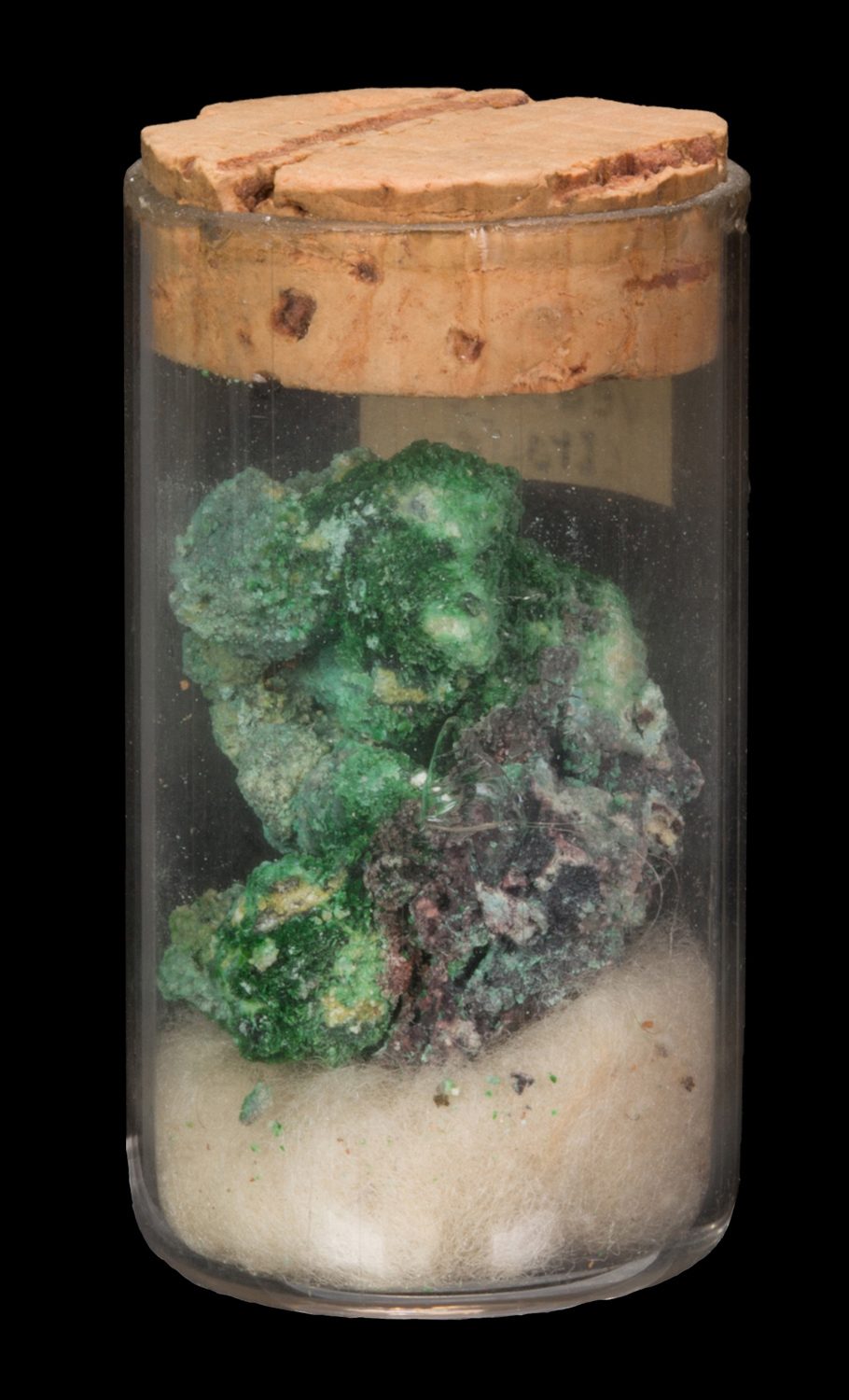
Euchlorine Locality: Mt Vesuvius, Somma-Vesuvius Complex, Naples Province, Campania, Italy Size: 4.8cm x 2.6cm x 2.6cm (bottle) Euchlorine, a rare K-Na-Cu sulfate found in volcanoes, is very rare from the famed Italian Type Locality. The cork-stoppered circular flask holds numerous emerald-green crystallized fragments of this rarity from the Type Locality. Ex Jean Behier and Eric Asselborn Collections. — Photo: Robert M. Lavinsky · CC BY-SA 3.0
Euchlorine
An emerald-green potassium-sodium-copper oxysulfate found as a fumarole sublimate — first collected from Vesuvius's 1868 eruption.
Intro adapted from Wikipedia (CC BY-SA).
Euchlorine is an IMA-recognized mineral species in the sulfate class, with the chemical formula KNaCu₃O(SO₄)₃.
It crystallizes in the monoclinic crystal system (space group C2/c). It is a member of the Euchlorine structural group.
Key properties: specific gravity 3.27; optically biaxial.
IMA symbol Ecr, grandfathered status — known before the IMA’s founding, named in 1884.
A rare sublimate around volcanic fumaroles.
It is found associated with Dolerophanite, eriochalcite, chalcocyanite, melanothallite (Vesuvius, Italy); stoiberite, fingerite, ziesite, thénardite, mcbirneyite (Izalco volcano.
Its name comes from the Greek for pale green, in allusion to the typical color.