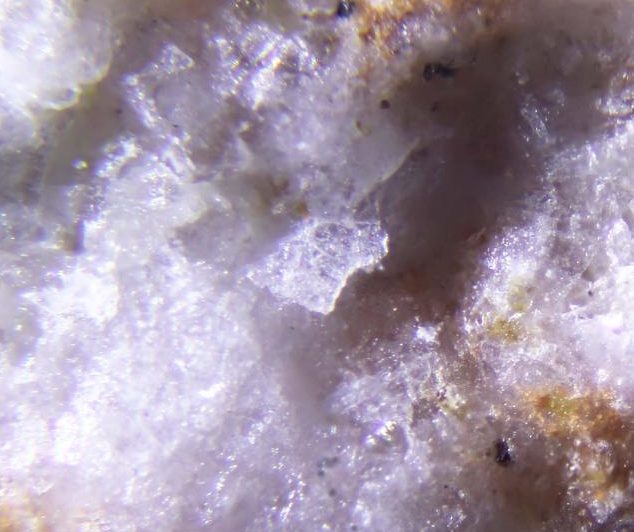
Outstanding white adamantine vitreous crystals of the extremely rare tellurium mineral fairbankite from the type locality in Tombstone (Grand Central Mine, Tombstone Hills, Cochise County, Arizona, United States of America) and only one of the two known localities worldwide, associated to a greenish Te mineral, probably emmonsite. Ex Vandenbroucke Museum collection from Waregem, Belgium. — Photo: David Hospital · CC BY 4.0
Fairbankite
Fairbankite is an IMA-recognized mineral species in the sulfate class, with the chemical formula Pb²⁺₁₂(Te⁴⁺O₃)₁₁(SO₄).
It crystallizes in the triclinic crystal system (space group P-1).
Key properties: Mohs hardness 2; Resinous to adamantine luster; optically biaxial.
IMA symbol Fbk, IMA status: approved, named in 1979.
Very rare on the mine dump from a hydrothermal Au-Te-bearing ore deposit.
It is found associated with Winstanleyite, cerussite, chlorargyrite, jarosite, rodalquilarite, “opal”.
The mineral was named to honor Nathaniel Kellogg Fairbank (1829-1903), who organized the company that developed the Grand Central lode, Tombstone, Arizona, USA.