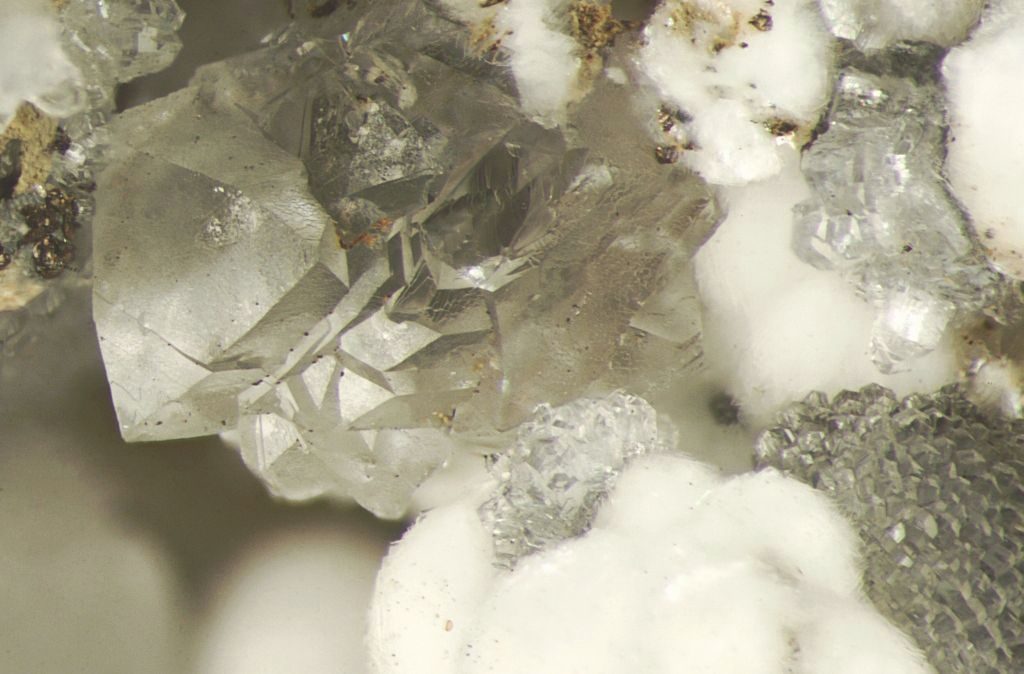
Faujasite-Na (FOV 3.6 x 2.4 mm) Locality: Poudrette quarry (Demix quarry; Uni-Mix quarry; Desourdy quarry; Carrière Mont Saint-Hilaire), Mont Saint-Hilaire, Rouville RCM, Montérégie, Québec, Canada This is a child photo of File:Faujasite-Na-170873.jpg . Half of a stereo pair rotated by 90 degrees — Photo: Modris Baum · Public domain
Faujasite-Na
Faujasite (FAU-type zeolite) is a mineral group in the zeolite family of silicate minerals. The group consists of faujasite-Na, faujasite-Mg and faujasite-Ca. They all share the same basic formula (Na2,Ca,Mg)3.5[Al7Si17O48]·32(H2O) by varying the amounts of sodium, magnesium and calcium. Faujasite occurs as a rare mineral in several locations worldwide. Faujasite materials are widely synthesized industrially. The relatively low-silica (Si/Al<2) synthetic faujasite is called Zeolite X and the high-silica (Si/Al>2) one is called Zeolite Y.
Intro adapted from Wikipedia (CC BY-SA).
Faujasite-Na is an IMA-recognized mineral species in the silicate class, with the chemical formula (Na,Ca,Mg)₂(Si,Al)₁₂O₂₄·15H₂O.
It crystallizes in the cubic crystal system (space group Fd3m).
Key properties: Mohs hardness 4.5–5; specific gravity 1.92–1.93; White streak; Vitreous to adamantine luster.
IMA symbol Fau-Na, IMA status: approved, named in 1842.
Rare, in vesicles of basalts, phonolites, and tuffs; formed by palagonization or authigenically.
It is found associated with Zeolites, olivine, augite, nepheline.
The mineral was named to honor Barth¶elemy Faujas de Saint Fond (1741–1819), French mineralogist and vulcanologist.