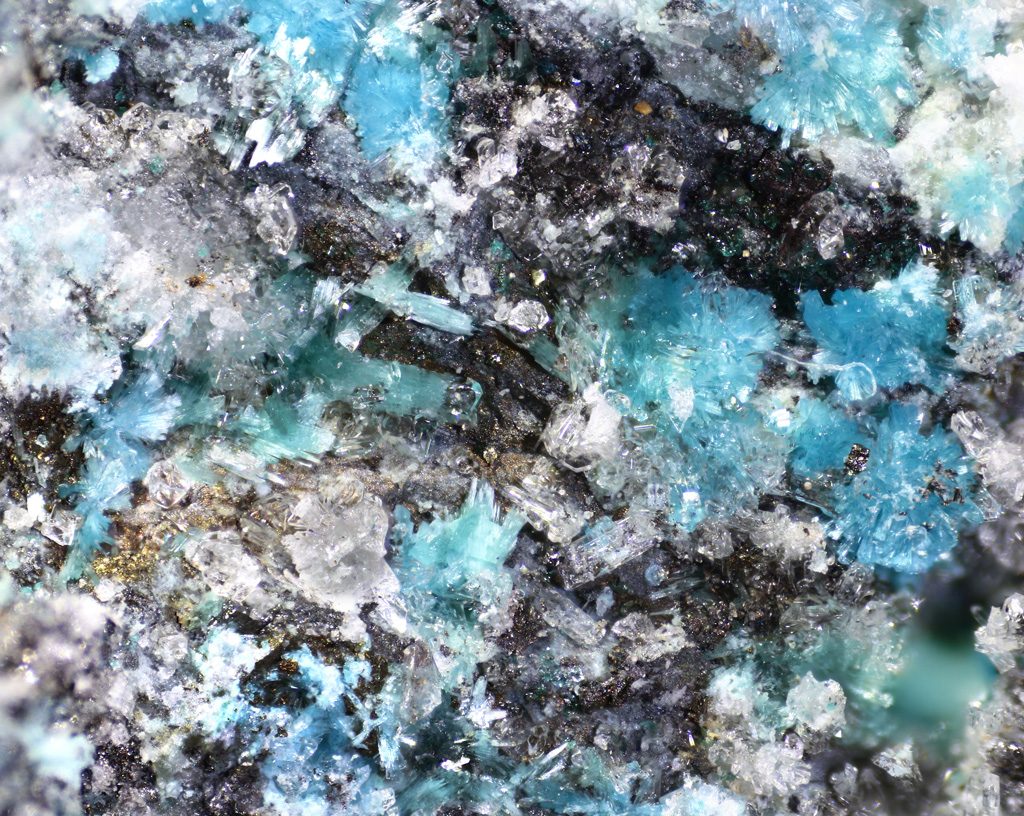
Fehrite is a recent new species found in Almeria (Spain). Some years ago (ca. 2012) we identified this species in the Les Ferreres mine (Camprodon) but unfortunatelly we didn't have enough sample to finish detrmination and structural studies. Recently we found some more samples and the characterization was carried out based on the results obtained from the application of various analytical techniques: SEM-EDS, Raman and X-ray diffraction. Les Ferreres mine is the second locality worldwide for the species. In this Catalan mine, fehrite appears as elongated elongated tabular crystals, with a delicate bluish-green tone, with fibrous terminations. Usually, it is accompanied by devilline (blue) and brochantite (green). It is the magnesium analogue of ktenasite. — Photo: Joan Rosell , from rosellminerals.com · CC BY-SA 4.0
Fehrite
A hydrated copper-magnesium sulfate approved in 2019 from Spain's Casualidad mine.
Intro adapted from Wikipedia (CC BY-SA).
Fehrite is an IMA-recognized mineral species in the sulfate class, with the chemical formula MgCu₄(SO₄)₂(OH)₆·6H₂O.
It crystallizes in the monoclinic crystal system (space group P2_1/c). It is a member of the Ktenasite structural group.
Key properties: Mohs hardness 2.73; specific gravity 2.73; Pale blue-green streak; Vitreous luster.
IMA symbol Feh, IMA status: approved, named in 2019.
Secondary oxidation product in tetrahedrite veinlets.
It is found associated with Clinoatacamite, kapellasite, gordaite, serpierite, connellite, gypsum.
The mineral was named to honor Karl Thomas Fehr (1954 -2014), Professor of Mineralogy, Department of Geo- and Environmental Sciences, Ludwig-Maximilians-University, Munich, Germany.