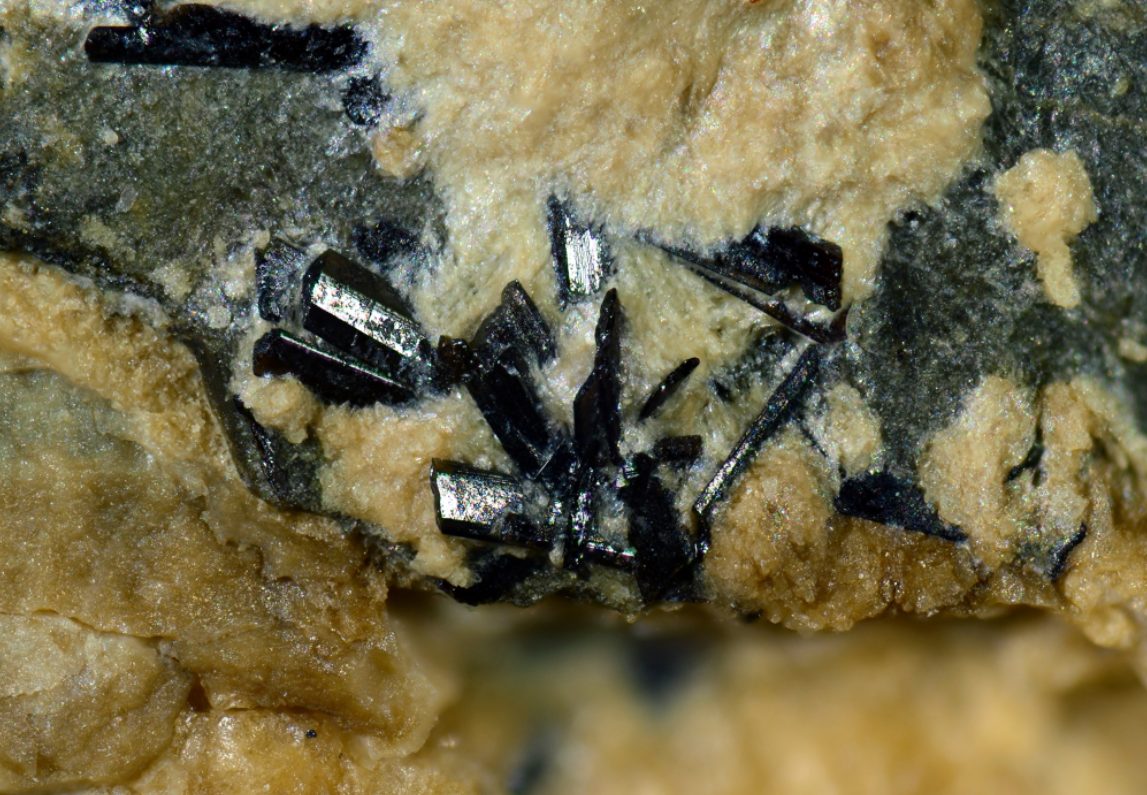
Ferriakasakaite-(La) and ferriandrosite-(La) crystal. These two minerals are visually indistinguishable, and are also identical in appearance as vanadoallanite-(La). In fact, ferriakasakaite-(La) and ferriandorosite-(La) were identified during an attempt to identify more vanadoallanite-(La) for further studies. All three minerals are found in the same rhodochrosite/tephroite veins in a ferromanganian ore. The photo is from the type material and is taken by Dr. Daisuke Nishio-Hamane, one of the co-authors of the species. — Photo: Dr. Daisuke Nishio-Hamane · CC BY 3.0
Ferriakasakaite-(La)
Ferriakasakaite-(La) is an IMA-recognized mineral species in the silicate class, with the chemical formula CaLaFe³⁺AlMn²⁺(Si₂O₇)(SiO₄)O(OH).
It crystallizes in the monoclinic crystal system (space group P2_1/m). It is a member of the Epidote structural group.
Key properties: Mohs hardness 6.5; specific gravity 4.22; Brown streak; Vitreous luster.
IMA symbol Fak-La, IMA status: approved, named in 2013.
Found in tephroite-calcite veinlets in a stratiform Fe-Mn deposit. In volcanic ejecta (Eifel).
It is found associated with Ferriandrosite-(La), rhodochrosite, bementite, allanite-group minerals (Japan). Nosean +/- haüyne, Mn-bearing biotite, magnetite.
The mineral was named to honor Professor Masahide Akasaka (b. 1950) for his study of minerals occurring in Mn-Fe ore deposits, particularly the natural and synthetic epidote-supergroup minerals.