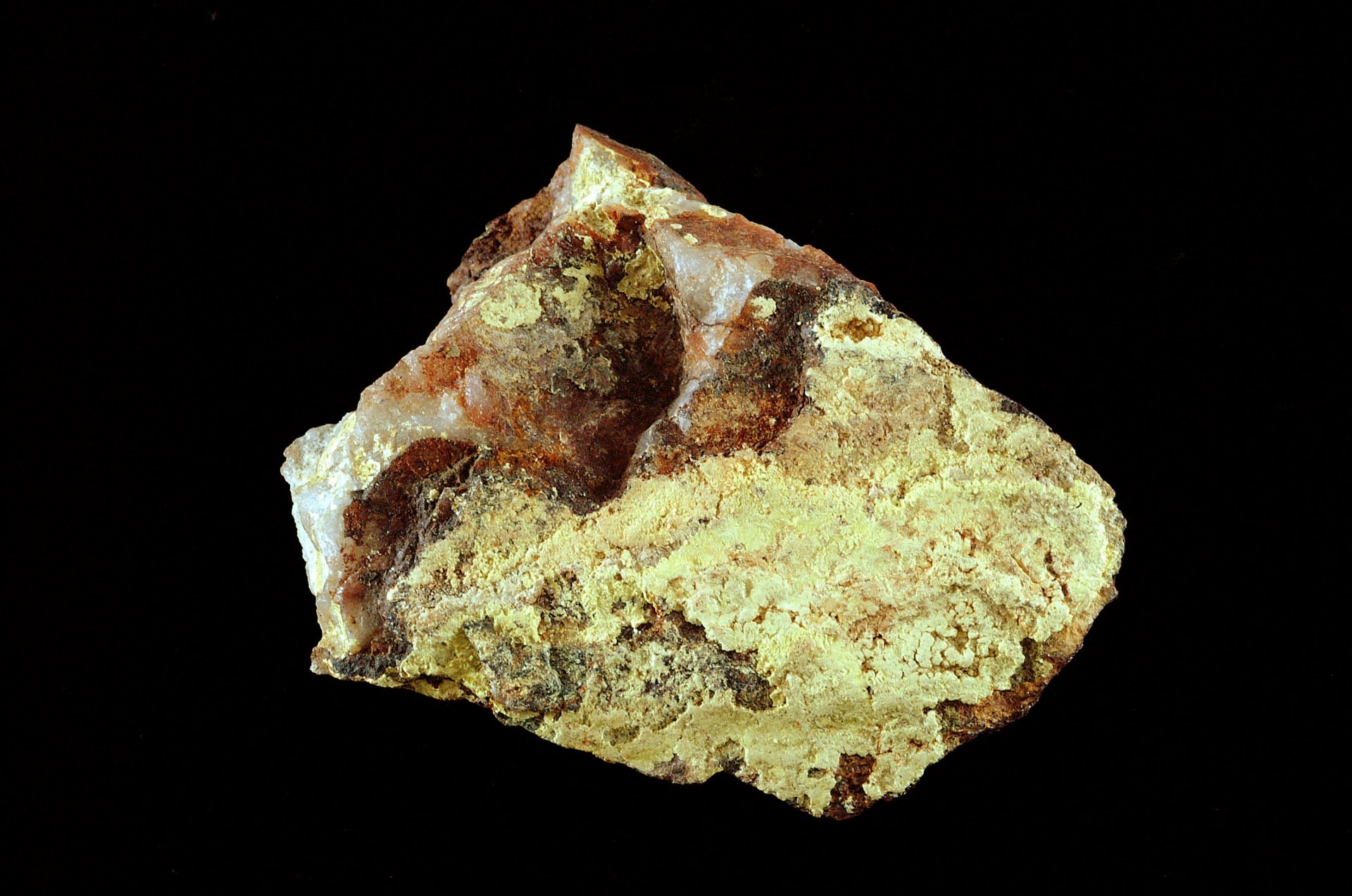
The yellow crust is ferrimolybdite, Fe2Mo3012·8H20, on brownish quartz. It is a hydrated iron molybdate mineral that occurs in the oxidized zone of molybdenum-bearing deposits. — Photo: Shannon Heinle · CC0
Ferrimolybdite
A hydrous iron molybdate forming soft yellow radial needle aggregates — a molybdenite-oxidation product.
Intro adapted from Wikipedia (CC BY-SA).
Ferrimolybdite is an IMA-recognized mineral species in the oxides & hydroxide class, with the chemical formula Fe³⁺₂(Mo⁶⁺O₄)₃·7H₂O.
Key properties: Mohs hardness 1–2; specific gravity 2.99; Pale yellow streak; Adamantine to silky, earthy luster; optically biaxial.
IMA symbol Fmyb, grandfathered status — known before the IMA’s founding, named in 1907.
Occurs as an uncommon secondary mineral in the oxidized portions of hydrothermal vein and porphyry-type molybdenum-bearing deposits.
It is found associated with Molybdenite, pyrite, chalcopyrite.
The name refers to its essential chemical components: FERRIc iron and MOLYBDate anionic group.