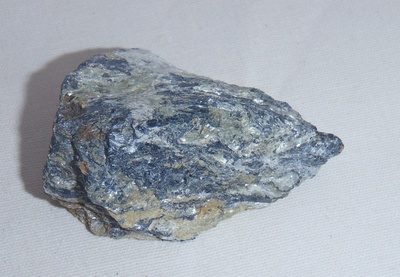
Dark blue needles of ferro-glaucophane from a former subduction zone; acquired from the late Dave Shannon at the Tucson Show in 1998. Locality: Groix island, Morbihan, Brittany, France. Collection and photo Erik Vercammen — Photo: Erik Vercammen · CC BY 3.0
Ferro-glaucophane
The iron analogue of glaucophane — a sodic amphibole of the blueschist-facies rocks.
Intro adapted from Wikipedia (CC BY-SA).
Ferro-glaucophane is an IMA-recognized mineral species in the silicate class, with the chemical formula Na₂(Fe²⁺₃Al₂)Si₈O₂₂(OH)₂.
It is a member of the Amphibole structural group.
Key properties: Mohs hardness 6; specific gravity 3.18–3.34; [Vitreous.] luster; optically biaxial.
IMA symbol Fgln, IMA status: approved, named in 1957.
Found in metamorphic rocks of the high-pressure, low-temperature blueschist facies, commonly derived from either siliceous sedimentary, alkalic basaltic, or felsic volcanic predecessors.
It is found associated with Paragonite, lawsonite, albite, spessartine, almandine, epidote, omphacite.
The name refers to its high ferrous iron content and similarity to glaucophane.