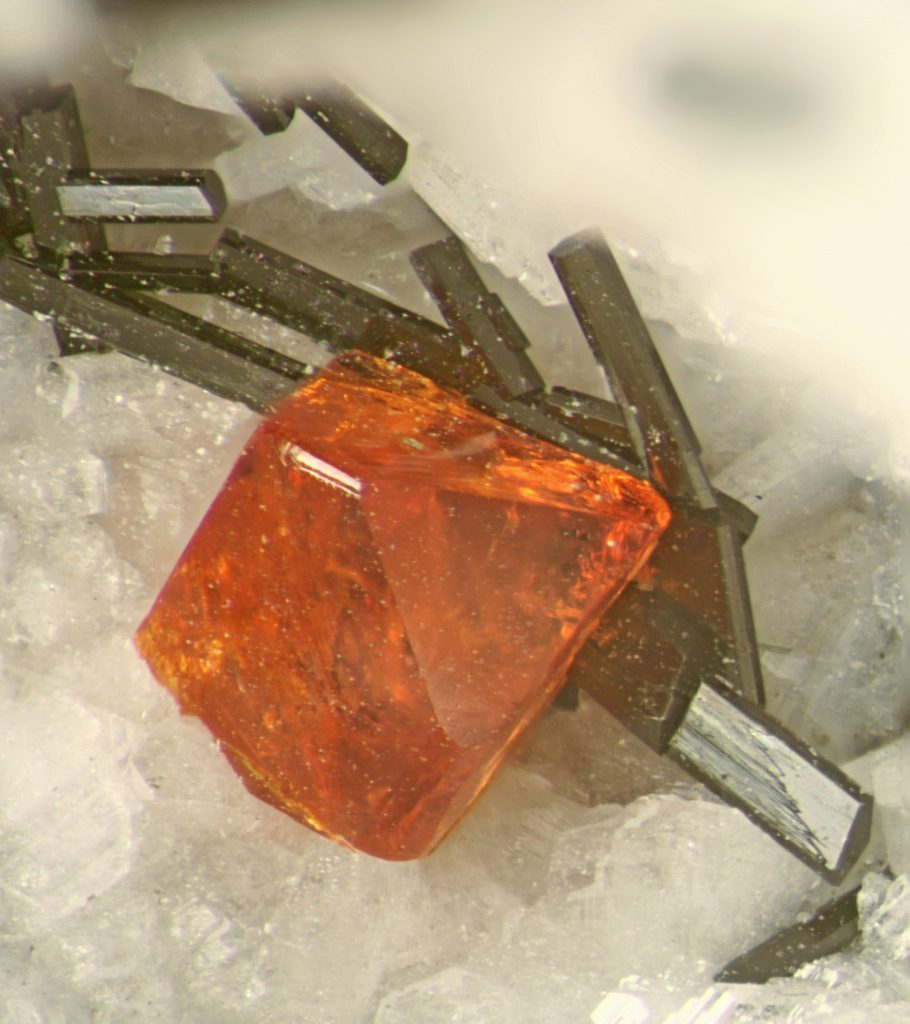
FOV 2.5 x 2.8 mm. Found August 1997 (Poudrette quarry, Mont Saint-Hilaire, La Vallée-du-Richelieu RCM, Montérégie, Québec, Canada). MOB coll. This specimen was identified at the Canadian Museum of Nature. It came from an igneous breccia and was associated with khomyakovite ( http://www.mindat.org/photo-166793.html and http://www.mindat.org/photo-166788.html ) and manganokhomyakovite ( http://www.mindat.org/photo-279269.html ) from which it is visually indistinguishable. (Most xls are zoned. This particular xl may or may not be predominantly ferrokentbrooksite but the analysis showed ferrokentbrooksite on this specimen and it appears to be the most common eudialyte group member in this find.) The dark prisms are probably an amphibole such as richterite. — Photo: Modris Baum · CC0
Ferrokentbrooksite
A moderately rare eudialyte-group mineral with iron-manganese in place of the usual cations.
Intro adapted from Wikipedia (CC BY-SA).
Ferrokentbrooksite is an IMA-recognized mineral species in the silicate class, with the chemical formula Na₁₅Ca₆Fe²⁺₃Zr₃Nb(Si₂₅O₇₃)(O,OH,H₂O)₃(F,Cl)₂.
It crystallizes in the hexagonal crystal system (space group R3m). It is a member of the Eudialyte structural group.
Key properties: Mohs hardness 5–6; specific gravity 3.06; White streak; Vitreous luster; optically uniaxial.
IMA symbol Fktb, IMA status: approved, named in 1999.
A late-stage phase in agpaitic pegmatite dikes in nepheline syenite in association with an alkaline intrusive complex.
It is found associated with Microcline, nepheline (partly altered to natrolite), fluorite, fluorapatite, natrolite, gonnardite, rhodochrosite, aegirine, albite, calcite, sérandite.
A prefix, ferro, indicates the Fe2+-dominant analog of kentbrooksite.