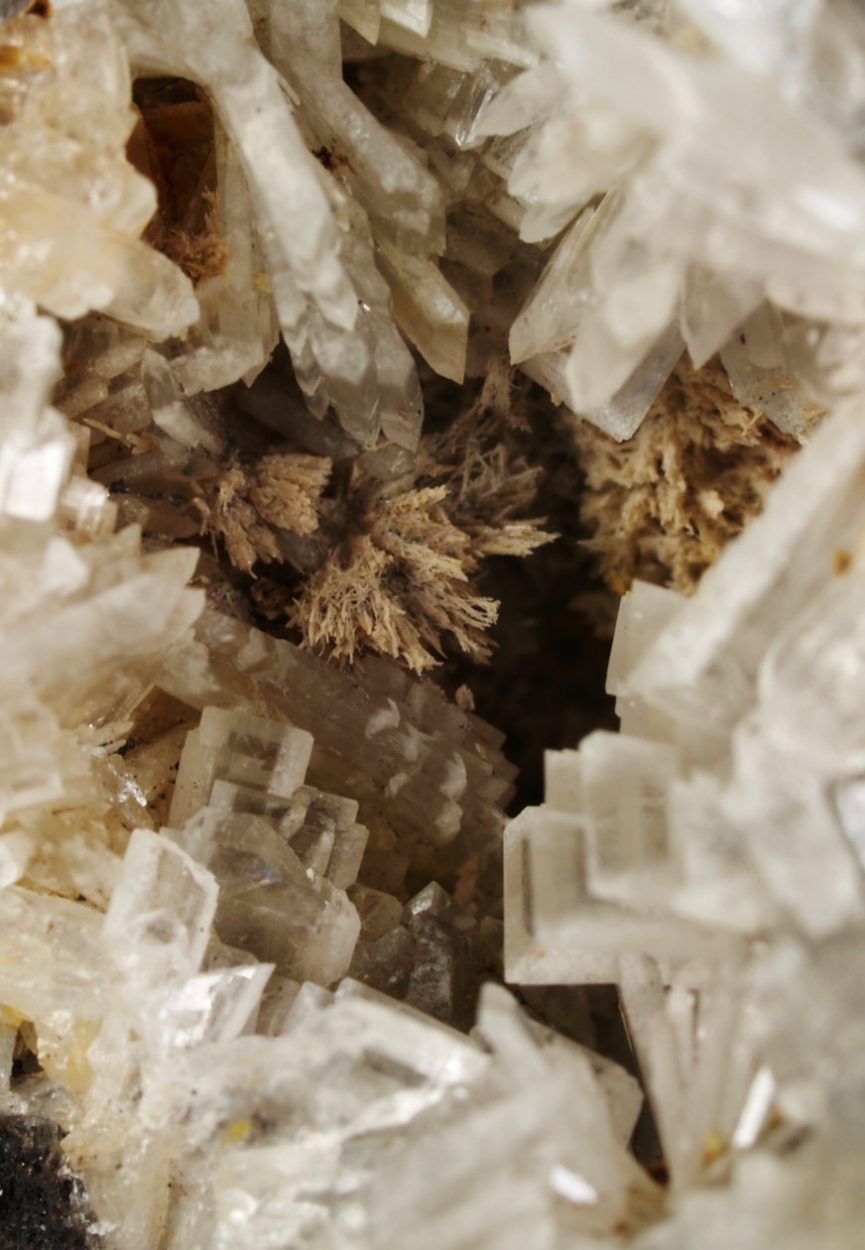
:Locality: Santa Matilde Quarry, Berja Mines, Las Herrerías, Andalusia, Spain Size: 7.4 × 5.5 × 5.2 cm Largest Crystal: 0.40cm Description: Analyzed species. At the beginning of 2014, reviewing some specimens from the Santa Matilde open pit we found into the vugs some groups of lanceolated, fibrous or equidimensional crystals, with pink, beige to white colours, those aroused our interest. After some analysis we could identify as fluorcalcioroméite species (Ca,Na)2Sb5+2O6(F,OH), with a small percentage of oxyplumboroméite (Pb2Sb2O7, due to the presence of lead). Both species belong to the isometric system. But the observed symmetry indicated that they are, highly probable, a pseudomorph after stibnite and/or bournonite crystals. This is the first report of this mineral in the Iberian Peninsula. Nowadays this quarry is completelly filled by rubble. In this specimen we can see some aggregates, one of them predominant, formed by several lanceolated to needle-like crystals, with luster, beige to ocher tone, accompanied by aesthetic baryte crystals. We will send a copy of the analysis (SEM-EDS, XRD) to the buyer. Collected: 2004 — Photo: Joan Rosell , from rosellminerals.com · CC BY-SA 4.0
Fluorcalcioroméite
Fluorcalcioroméite is an IMA-recognized mineral species in the halide class, with the chemical formula (Ca,Na)₂Sb⁵⁺₂O₆F.
It crystallizes in the cubic crystal system (space group Fd-3m). It is a member of the Pyrochlore-Roméite structural group.
IMA symbol Fcrm, IMA status: approved, named in 2012.