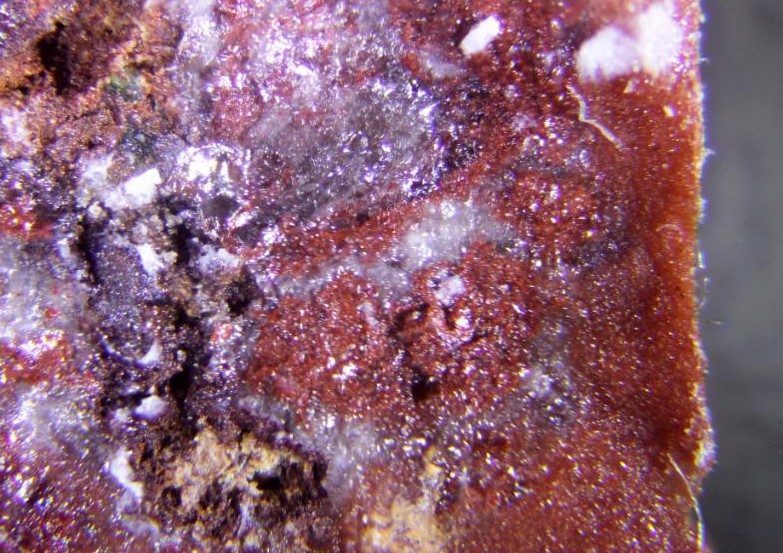
Reddish brown microcrystals of the extremely rare Mn-uranium mineral fritzcheite from the type locality for the mineral in Georg Wagsfort Mine, Johanngeorgenstadt (Erzgebirge, Saxony, Germany). Ex Vandenbroucke Museum collection from Waregem, Belgium. — Photo: David Hospital · CC BY 4.0
Fritzscheite
Fritzscheite is an IMA-recognized mineral species in the phosphate class, with the chemical formula Mn²⁺(UO₂)₂(VO₄,PO₄)₂·4H₂O.
It crystallizes in the orthorhombic crystal system (space group Pnam). It is a member of the Fritzscheite structural group.
Key properties: Mohs hardness 2.25–3; specific gravity 3.504; Reddish brown to hyacinth-red streak; Vitreous to pearly luster.
IMA symbol Fzs, grandfathered status — known before the IMA’s founding, named in 1865.
Found in a hematite deposit (Nove Hamry, Czech Republic).
It is found associated with Autunite, torbernite.
The mineral was named to honor Professor Carl Julius Fritzsche (1808–1871), German chemist.