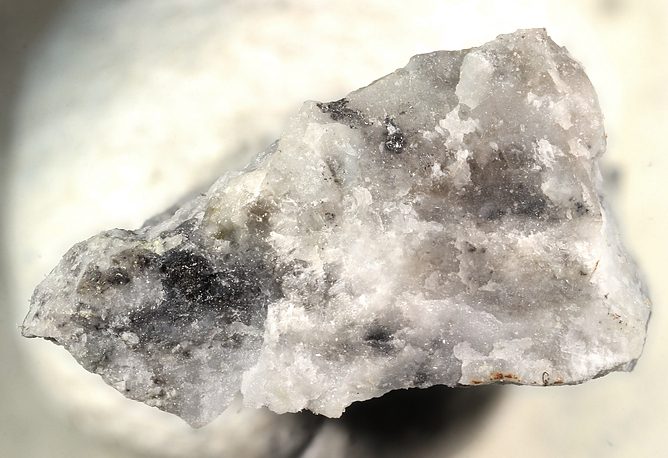
Fukalite is a rare white-to-pale-brown mineral discovered in 1977 at the Fuka mine in Japan. It forms when cooling, CO2-rich fluids alter high-temperature skarn minerals like spurrite, resulting in delicate platy or fibrous aggregates. — Photo: Thepastsday · CC0
Fukalite
A rare calcium silicate-carbonate discovered in 1977 at Japan's Fuka mine.
Intro adapted from Wikipedia (CC BY-SA).
Fukalite is an IMA-recognized mineral species in the silicate class, with the chemical formula Ca₄Si₂O₆(CO₃)(OH)₂.
It crystallizes in the monoclinic crystal system (space group Bmmb).
Key properties: Mohs hardness 4; specific gravity 2.77.
IMA symbol Fk, IMA status: approved, named in 1976.
A retrograde mineral and alteration product in skarns formed from metasomatism of limestone.
It is found associated with Cuspidine, xonotlite, calcite, spurrite, hillebrandite, scawtite, foshagite, wollastonite, fluorite, gehlenite, perovskite, grossular, hydrogrossular.
The name is derived from the locality where it was first discovered, Fuka, Japan.