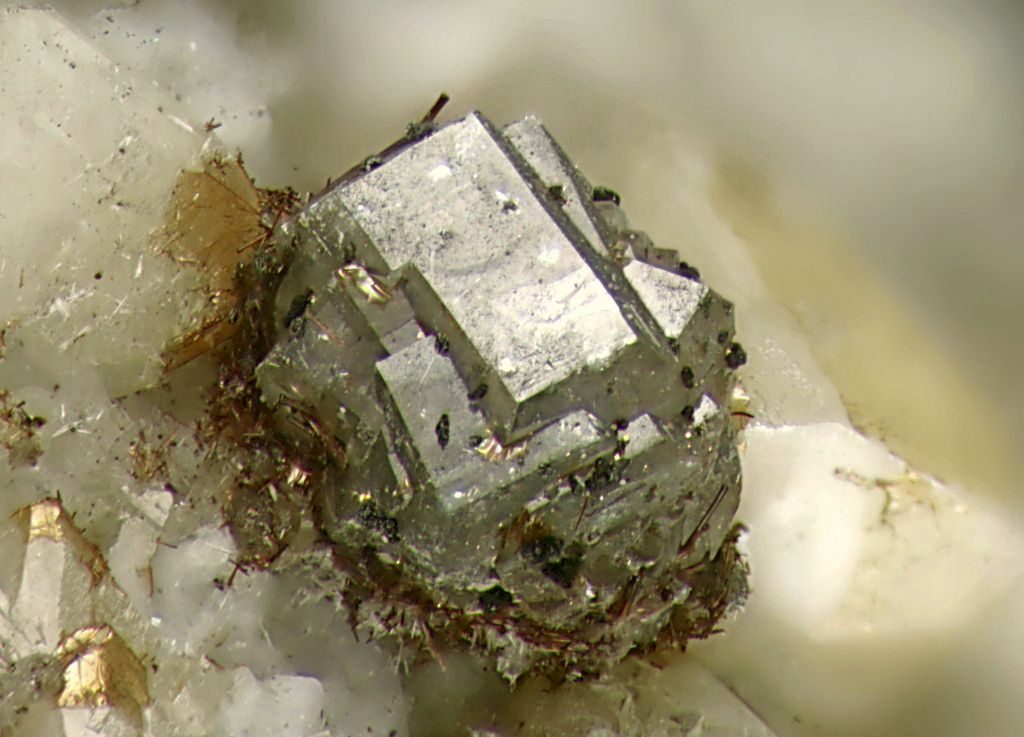
:A good example of gaidonnayite from MSH. It has relatively simple twinning with recognizable morphology and is of decent size. Unlike most gaidonnayite at MSH, this is from a brecciated hornfels rather than a pegmatite. Also unlike most gaidonnayite,it has only very weak fluorescence. The color is medium gray - perhaps due to inclusions of pyrite - with a blueish tint. From: Poudrette quarry, Mont Saint-Hilaire, La Vallée-du-Richelieu RCM, Montérégie, Québec, Canada. FOV 3.1 x 2.3 mm. Found April 1997. MOB coll. — Photo: Modris Baum · CC0
Gaidonnayite
Gaidonnayite is an IMA-recognized mineral species in the silicate class, with the chemical formula Na₂ZrSi₃O₉·2H₂O.
It crystallizes in the orthorhombic crystal system (space group P2_1nb). It is a member of the Gaidonnayite structural group.
Key properties: Mohs hardness 5; specific gravity 2.67; White streak; Vitreous luster; optically biaxial.
IMA symbol Gdn, IMA status: approved, named in 1973.
Found in miarolitic cavities in nepheline syenite and altered pegmatite dikes in an intrusive alkalic gabbro-syenite complex (Mont Saint-Hilaire, Canada); in augite syenite (Narss^arssuk, Greenland).
It is found associated with Siderite, analcime, hilairite, aegirine, calcite, albite, catapleiite, zircon, pyrochlore, ancylite, burbankite (Mont Saint-Hilaire, Canada); vlasovite.
The name refers to Professor Gabrielle Donnay (1920–1987), mineralogist of McGill University, Montreal, Quebec, Canada.