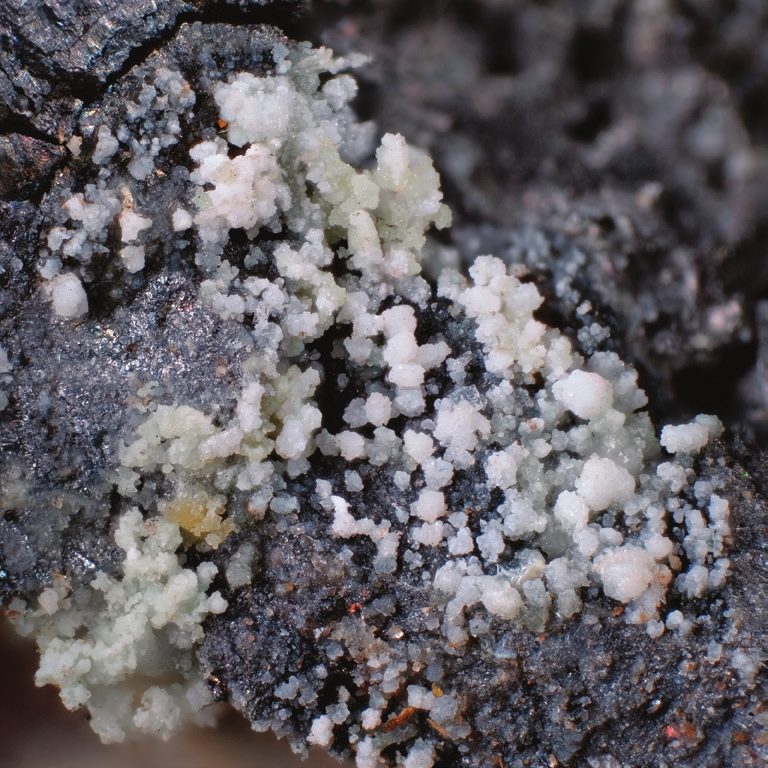
White aggregates mainly composed of gajardoite-(NH 4 ) on the skutterudite-safflorite matrix. Holotype sample. Field of view of 2 × 2 mm. Photo by Maria D. Milshina. — Photo: Maria D. Milshina · CC BY 4.0
Gajardoite
Gajardoite is an IMA-recognized mineral species in the halide class, with the chemical formula KCa₀.₅As³⁺₄O₆Cl₂·5H₂O.
It crystallizes in the hexagonal crystal system (space group P6/mmm).
Key properties: Mohs hardness 1.5; specific gravity 2.64; White streak; Vitreous luster; optically uniaxial.
IMA symbol Gaj, IMA status: approved, named in 2015.
A secondary mineral from the oxidation of native arsenic and other As -bearing primary phases, followed by later alteration by saline fluids derived from evaporating meteoric water under hyperarid conditions.
It is found associated with Native arsenic, arsenolite, chongite, talmessite, torrecillasite.
The mineral was named to honor Dr. Anibal Gajardo Cubillos (b. 1945), a prominent Chilean geologist and academician.