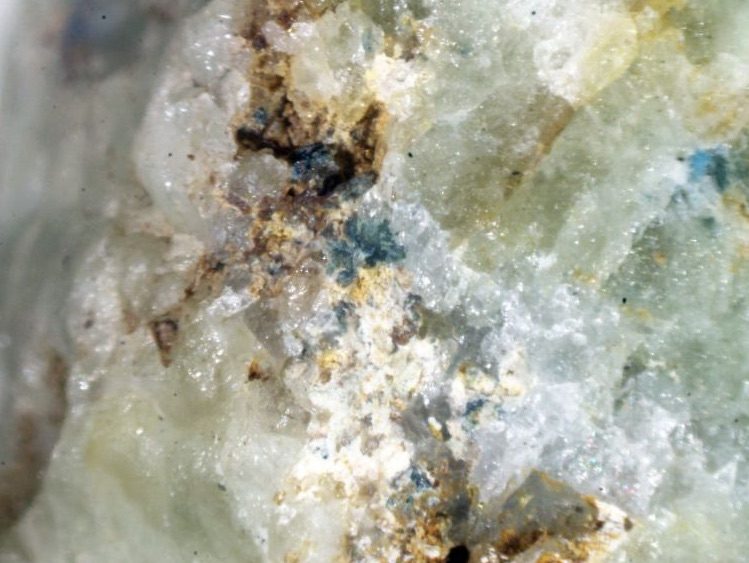
Blue burangaite crystals associated to white gatumbaite from the type locality for both minerals: Buranga Pegmatite, Gatumba, Ngororero District, Western Province, Rwanda. Associated mineral after the label is brazilianite but this species could not be identified in the specimen. Ex Vandenbroucke Museum collection from Waregem, Belgium. — Photo: David Hospital · CC BY-SA 4.0
Gatumbaite
Gatumbaite is an IMA-recognized mineral species in the phosphate class, with the chemical formula CaAl₂(PO₄)₂(OH)₂·H₂O.
It crystallizes in the monoclinic crystal system.
Key properties: Mohs hardness 5; specific gravity 2.92; Pearly luster; optically biaxial.
IMA symbol Gtb, IMA status: approved, named in 1976.
From the phosphate assemblage in a complex granite pegmatite (Buranga pegmatite, Rwanda; Hålsjöberg, Sweden.); in andesites altered hydrothermally through hydrogen metasomatism (Mt. Perry, Australia).
It is found associated with Trolleite, scorzalite, apatite, bjarebyite, burangaite (Buranga pegmatite, Rwanda); trolleite, augelite, andalusite, rutile, topaz, quartz (Mt. Perry.
The name refers to its occurrence near Gatumba, Rwanda.