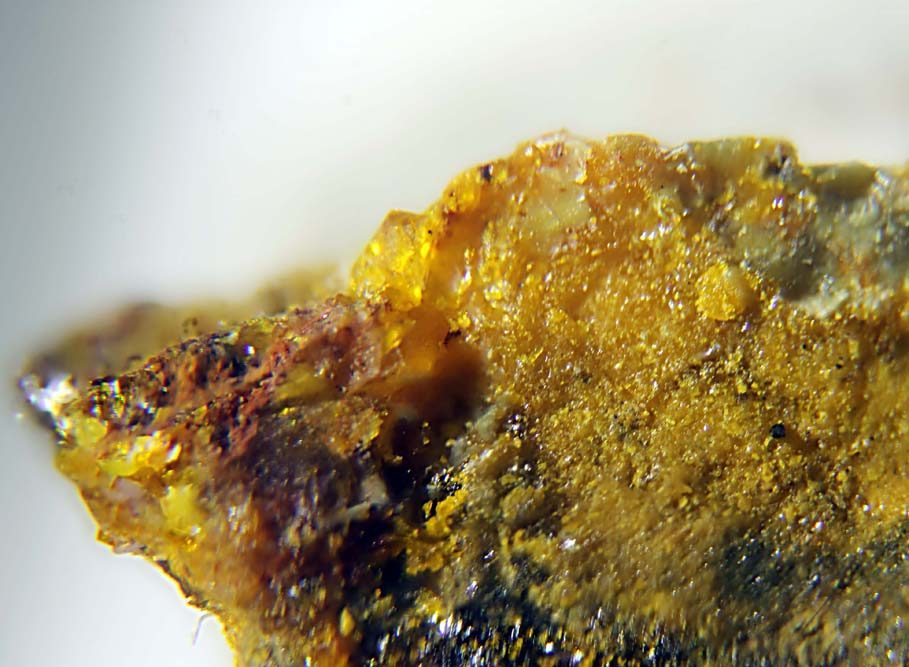
Yellow orange sharp crystals of the very rare uranium mineral gauthierite (IMA 2016-004) named in honour of the famous Gilbert Gauthier, expert on uranium minerals from Katanga. Analyzed specimen by SEM-EDS and XRD. From: Shinkolobwe Mine, Shinkolobwe, Kambove, Haut-Katanga, DR Congo. — Photo: David Hospital · CC BY-SA 4.0
Gauthierite
A radioactive orange hydrated lead-potassium uranyl oxide — a very rare uranium mineral.
Intro adapted from Wikipedia (CC BY-SA).
Gauthierite is an IMA-recognized mineral species in the oxides & hydroxide class, with the chemical formula KPb[(UO₂)₇O₅(OH)₇]·8H₂O.
It crystallizes in the monoclinic crystal system (space group P2_1/c).
Key properties: Mohs hardness 3–4; specific gravity 5.437; Light orange streak; Vitreous luster; optically biaxial.
IMA symbol Gut, IMA status: approved, named in 2016.
A product of the oxidation-hydration weathering of uraninite and presumably formed by the combination of radiogenic lead and uranium from altered uraninite with potassium leached from gangue minerals.
It is found associated with Uraninite, quartz, soddyite, a metazeunerite-metatorbernite series mineral.
The mineral was named to honor Gilbert Joseph Gauthier (1924-2006), a Belgian geologist, mineralogist and connoisseur of Katanga minerals. He found the mineral and provided it for study.