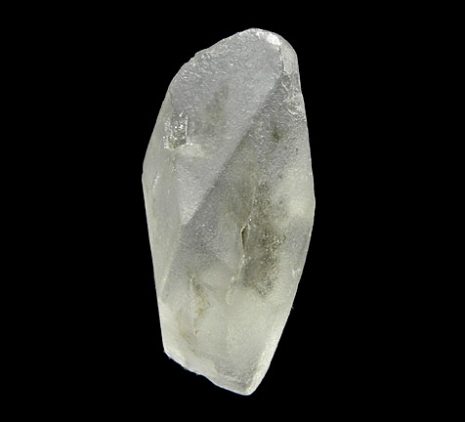
Gaylussite Locality: Lake Amboseli, Rift Valley Province , Kenya ( Locality at mindat.org ) Size: 3.1 x 1.5 x 1.4 cm Gaylussite is chemically a fairly simple carbonate mineral, but is not commonly found around the world. The crystals are typically grey, colorless or whitish in appearance, and can be quite gemmy from certain localities. This doubly-terminated, rather gemmy, sharp, well-formed, colorless to brownish crystal is an excellent example of the species. One of the few I have handled, and certainly one of the best single "floater" crystals I have seen. Ex. Richard Kosnar Collection. — Photo: Robert M. Lavinsky · CC BY-SA 3.0
Gaylussite
A hydrated sodium-calcium carbonate forming translucent monoclinic prisms in evaporite lake deposits.
Intro adapted from Wikipedia (CC BY-SA).
Gaylussite is an IMA-recognized mineral species in the carbonate class, with the chemical formula Na₂Ca(CO₃)₂·5H₂O.
It crystallizes in the monoclinic crystal system (space group C2/c).
Key properties: Mohs hardness 2.5–3; specific gravity 1.991; White to pale gray streak; Vitreous luster; refractive index 1.494; optically biaxial.
IMA symbol Gyl, grandfathered status — known before the IMA’s founding, named in 1826.
is typically found in evaporites or shales from alkali lakes; rarely in veinlets cutting alkalic igneous rocks.
It is found associated with Shortite, northupite, pirssonite, trona (Green River Formation, Wyoming, USA); thermonatrite, shortite, villiaumite, ferrian “biotite”, pectolite.
The mineral was named to honor Joseph Louis Gay-Lussac (1778–1850), noted French chemist and physicist.