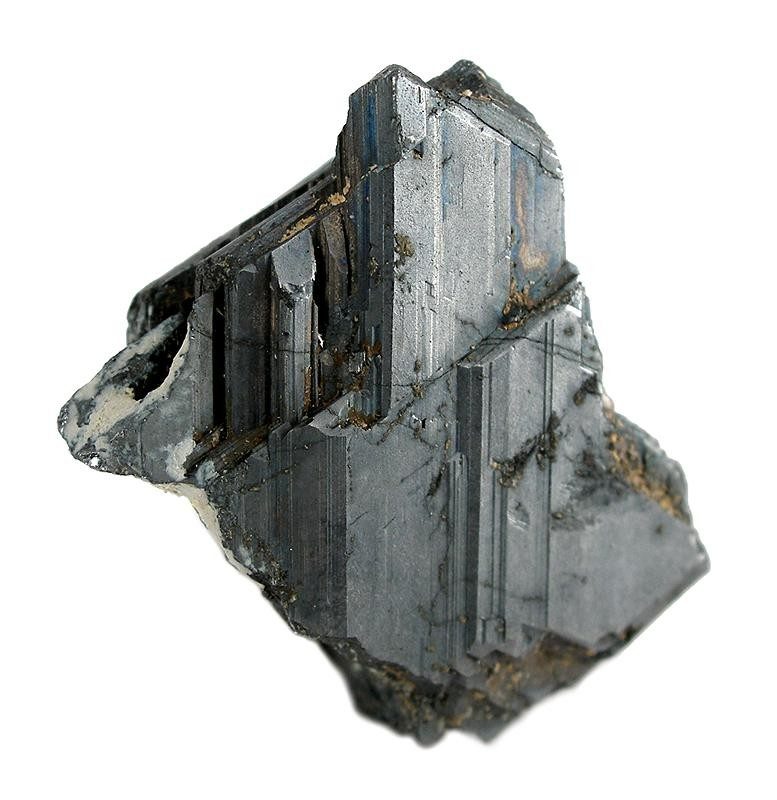
Geocronite Locality: Pollone mine, Valdicastello Carducci, Pietrasanta , Apuan Alps , Lucca Province , Tuscany , Italy ( Locality at mindat.org ) Size: 2.7 x 2.4 x 1.3 cm. This is a VERY rare lead sufosalt with moderately large crystals. The color is battleship gray, with a satiny luster. The crystals are foliated in parallel growth, much like mica. This species is not often seen in dealers stocks or even in museums. I am told it was collected prior to 1840. — Photo: Robert M. Lavinsky · CC BY-SA 3.0
Geocronite
A lead-antimony-arsenic sulfosalt — the antimony-rich end of a solid-solution series.
Intro adapted from Wikipedia (CC BY-SA).
Geocronite is an IMA-recognized mineral species in the sulfosalt class, with the chemical formula Pb₁₄Sb₆S₂₃.
It crystallizes in the monoclinic crystal system (space group P2_1/m). It is a member of the Geocronite structural group.
Key properties: Mohs hardness 2.5; specific gravity 6.46; Pale lead-gray to grayish blue streak; Metallic luster.
IMA symbol Geo, grandfathered status — known before the IMA’s founding, named in 1841.
Found in hydrothermal veins with sulfides and other sulfosalt minerals.
It is found associated with Galena, pyrite, tetrahedrite, barite, fluorite, quartz.
Its name comes from the Greek for Earth and Saturn, the alchemistic name for lead.