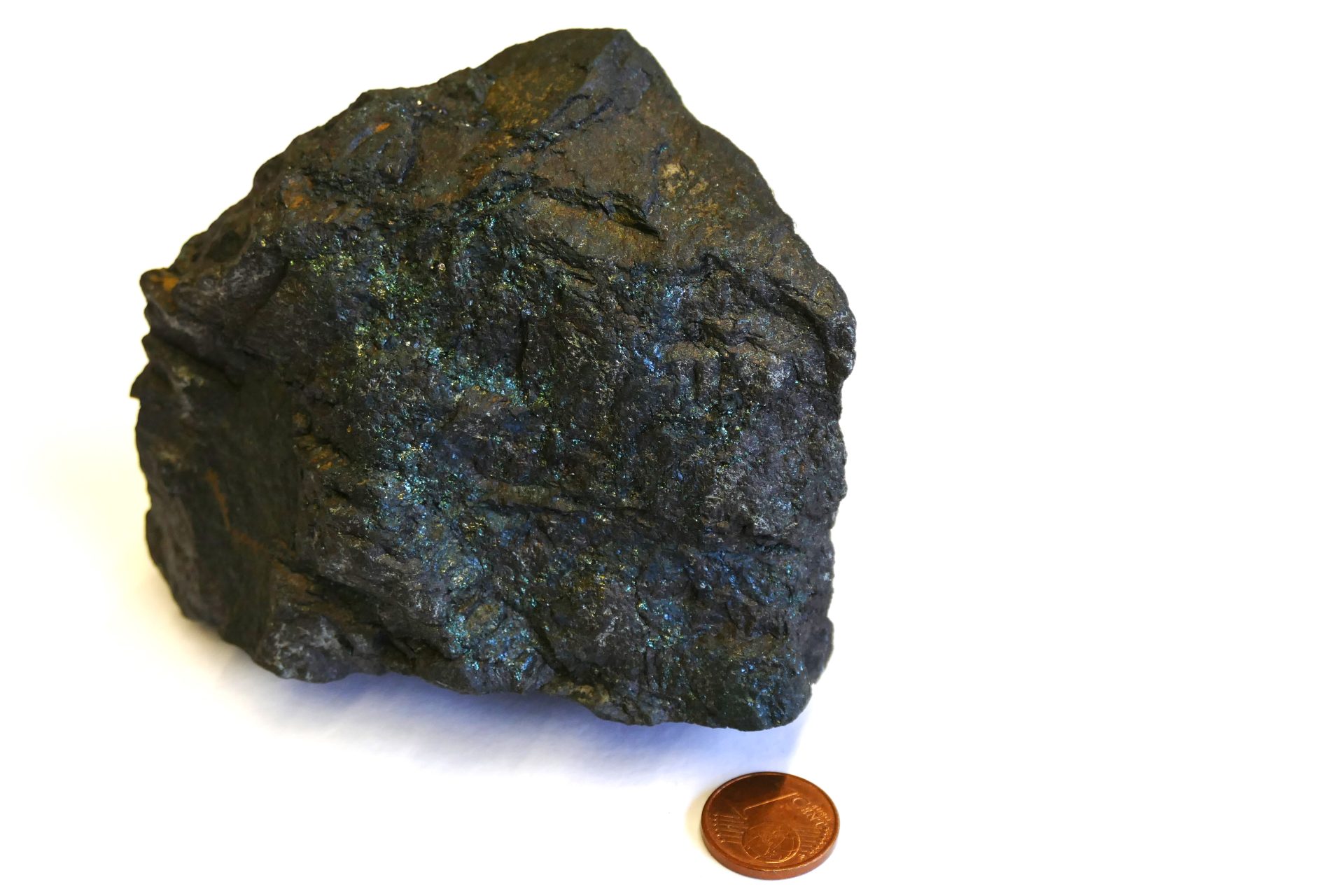
Germanite from Tsuneb, Namibia with a Eurocent as size comparison — Photo: Kritzolina · CC BY-SA 4.0
Germanite
A rare copper-iron-germanium sulfide discovered in 1922 — only a minor source of germanium, which mostly comes from sphalerite processing.
Intro adapted from Wikipedia (CC BY-SA).
Germanite is an IMA-recognized mineral species in the sulfide class, with the chemical formula Cu₁₃Fe₂Ge₂S₁₆.
It crystallizes in the cubic crystal system (space group P-43n). It is a member of the Sphalerite, Germanite structural group.
Key properties: Mohs hardness 4; specific gravity 4.46–4.59; Dark gray to black streak; Metallic, dull. R: (400) 21.9, (420) 21.5, (440) 21.1, (460) 20.6, (480) 20.0, (500) 19.6, (520) 19.7, (540) 20.2 luster.
IMA symbol Ger, grandfathered status — known before the IMA’s founding, named in 1922.
Found in primary Cu–Pb–Zn ores in a dolostone-hosted hydrothermal polymetallic ore deposit (Tsumeb, Namibia).
It is found associated with Reniérite, pyrite, tennantite, enargite, galena, sphalerite, digenite, bornite, chalcopyrite.
The name refers to the germanium content of the mineral.