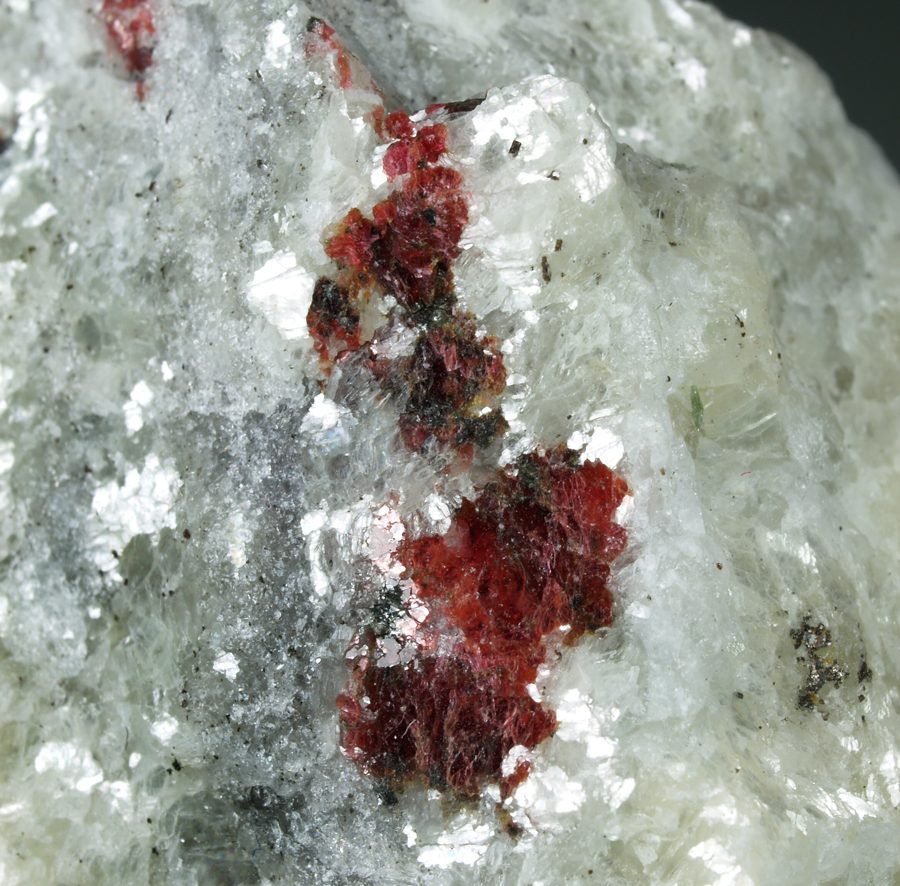
:Locality: La Madrelena Mine, Tres Pozos, Baja California Norte, Mexico Size: 5.5 × 4.5 × 3.5 cm Largest Crystal: 1.10cm Description: Thin platy veins of lustrous and translucent, rich strawberry-colored gillespite are emplaced in beautifully color contrasting white mica-like plates of sanbornite. Gillespite is a rare barium, iron silicate and sanbornite is a barium silicate. Accompanied also by brown taramellite. This is a colorful piece of the species. Ex. Renaud Vochten (USA) collection. Collected: 1994 — Photo: Joan Rosell , from rosellminerals.com · CC BY-SA 4.0
Gillespite
Gillespite is an IMA-recognized mineral species in the silicate class, with the chemical formula BaFe²⁺Si₄O₁₀.
It crystallizes in the tetragonal crystal system (space group P4/ncc). It is a member of the Gillespite structural group.
Key properties: Mohs hardness 3–4; specific gravity 3.39–3.4; Pink streak; Vitreous luster; optically uniaxial.
IMA symbol Gls, IMA status: approved, named in 1922.
Found in a glacial moraine (Dry Delta, Alaska, USA); probably from a contact metamorphic zone (Trumbull Peak, California, USA).
It is found associated with Celsian, hedenbergite, quartz (Dry Delta, Alaska, USA); sanbornite, celsian, diopside, tourmaline, quartz, pyrrhotite (Trumbull Peak, California, USA).
The name refers to Frank Gillespie, of Richardson, Alaska, USA, who discovered the first specimen.