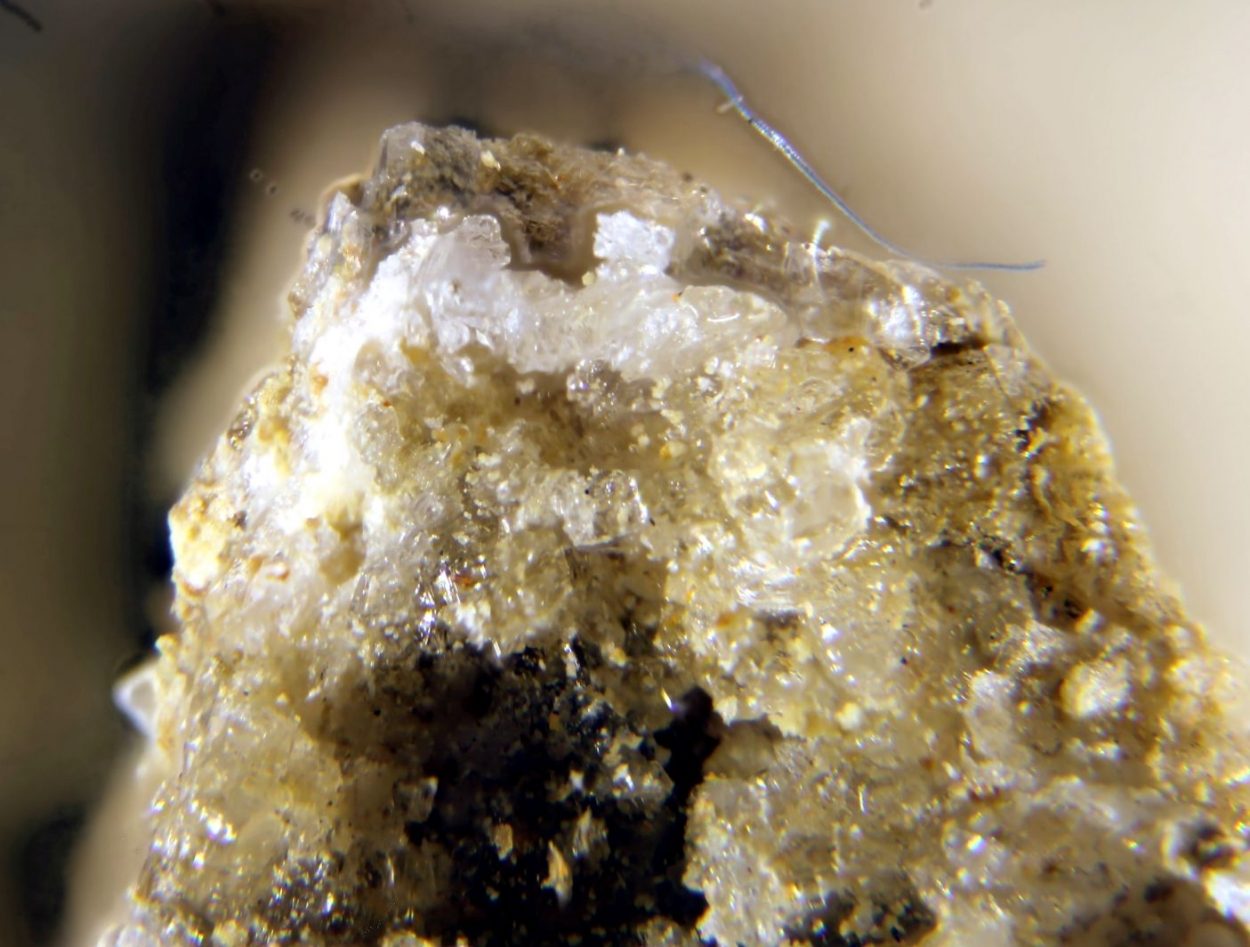
White crystals of the rare borate mineral ginorite from Death Valley (Death Valley, Inyo County, California, United States of America) on a dark contrasting matrix. — Photo: David Hospital · CC BY-SA 4.0
Ginorite
Ginorite is an IMA-recognized mineral species in the oxides & hydroxide class, with the chemical formula Ca₂B₁₄O₂₀(OH)₆·5H₂O.
Key properties: Mohs hardness 3.5; specific gravity 2.07–2.14; optically biaxial.
IMA symbol Gnr, grandfathered status — known before the IMA’s founding, named in 1934.
Occurs as efflorescences on weathered basalt in association with colemanite-bearing limestone (Death Valley, California, USA); in veins in sandstone (Sasso Pisano, Italy).
It is found associated with Calcite (Sasso Pisano, Italy); mirabilite, gypsum, anhydrite (Windsor, Canada); sassolite, colemanite, mcallisterite (Death Valley, California, USA).
The mineral was named to honor Prince Piero Ginori Conti (1865–1939), Florence, Italy, for his contributions to the Tuscan borax industry.