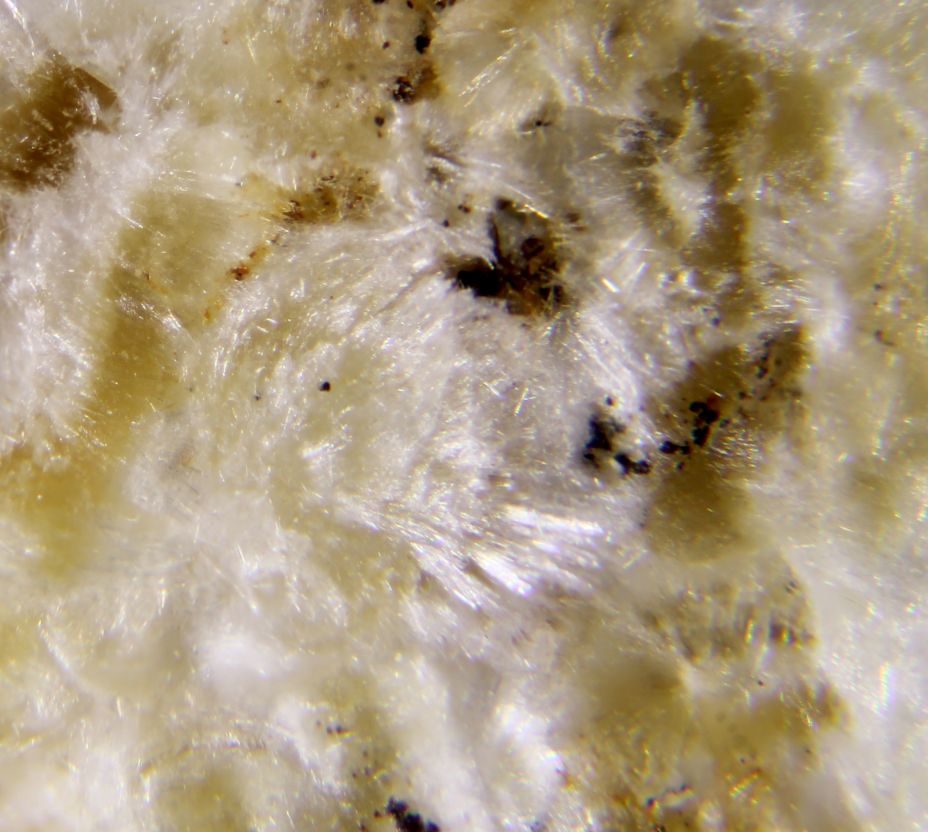
White crystals of the rare Ca-Be phosphate mineral glucine from the type locality in Russia (Boevskoe Be Deposit, Kaslinsky District, Chelyabinsk Oblast, Russian Federation). Only two known localities worldwide. Ex Vandenbroucke Museum collection specimen, from Waregem, Belgium. — Photo: David Hospital · CC BY-SA 4.0
Glucine
A rare calcium-beryllium phosphate named for the old name of beryllium — 'glucinium', from the sweet taste of its salts.
Intro adapted from Wikipedia (CC BY-SA).
Glucine is an IMA-recognized mineral species in the phosphate class, with the chemical formula CaBe₄(PO₄)₂(OH)₄·0.5H₂O.
IMA symbol Glu, IMA status: approved, named in 1963.
Occurs as segregations in mica-fluorite greisen in illite rocks (Boevskoye deposit, Russia).
It is found associated with Moraesite, fluorite, rutile, "limonite", quartz, mica-clay minerals (Boevskoye deposit, Russia); mitridatite, moraesite, siderite, tourmaline, albite (Paris.
The name comes from the Latin glucinium, beryllium, for its content of that element.