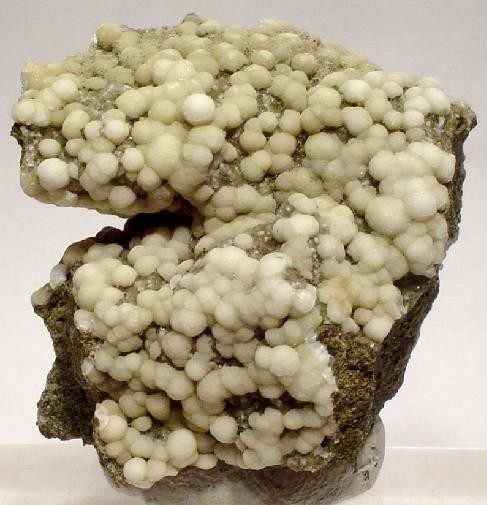
Gonnardite Locality: Boral Limited quarry, Bundoora , Victoria , Australia ( Locality at mindat.org ) Off-white balls of gonnardite to 3 mm literally cover the nicely shaped basalt matrix of this specimen from the 1989 find at the Boral Quarry, Bundoora, Victoria, Australia. Gonnardite is an uncommon zeolite and this is excellent material. 3.1 x 2.8 x 2.8 cm — Photo: Robert M. Lavinsky · CC BY-SA 3.0
Gonnardite
A fibrous zeolite of the natrolite subgroup — a hydrated sodium-calcium aluminosilicate.
Intro adapted from Wikipedia (CC BY-SA).
Gonnardite is an IMA-recognized mineral species in the silicate class, with the chemical formula (Na,Ca)₂(Si,Al)₅O₁₀·3H₂O.
It crystallizes in the tetragonal crystal system (space group I-42d). It is a member of the Natrolite structural group.
Key properties: Mohs hardness 5; specific gravity 2.25–2.36; Silky luster; refractive index 1.516; optically biaxial.
IMA symbol Gon, IMA status: approved, named in 1896.
Found in cavities in basalt, leucite tephrite, and altered skarn.
It is found associated with Zeolites, calcite.
The name refers to Ferdinand Gonnard, French mineralogist, Lyons, France, who first noted the mineral.