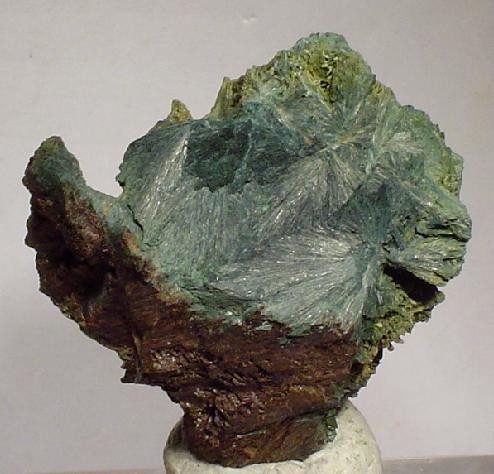
Gormanite Locality: Linópolis, Divino das Laranjeiras , Doce valley, Minas Gerais , Southeast Region, Brazil ( Locality at mindat.org ) Size: 4.2 x 4.2 x 3.0 cm. Gormanite is an ULTRA-RARE phosphate. Most crystals are small and are usually associated with the Yukon, Canada Type Localities - Rapid Creek and Big Fish River. This EXCELLENT and sculptural specimen consists of LARGE, lustrous, deep sea-green, radiating clusters of acicular crystals RICHLY dispersed in a contrasting chocolate-brown matrix. This SUPER piece is from a small and recent find near Linopolis, Brazil. — Photo: Robert M. Lavinsky · CC BY-SA 3.0
Gormanite
An iron-magnesium-aluminium phosphate named for University of Toronto professor Donald Gorman.
Intro adapted from Wikipedia (CC BY-SA).
Gormanite is an IMA-recognized mineral species in the phosphate class, with the chemical formula Fe²⁺₃Al₄(PO₄)₄(OH)₆·2H₂O.
It crystallizes in the triclinic crystal system (space group P-1). It is a member of the Souzalite structural group.
Key properties: Mohs hardness 4–5; specific gravity 3.1–3.13; Pale green streak; Vitreous luster; refractive index 1.644; optically biaxial.
IMA symbol Gm, IMA status: approved, named in 1977.
Occurs as low-temperature fracture fillings in phosphate-ironstones (Yukon Territory, Canada); in fractures in tonalite (Bisbee, Arizona, USA).
It is found associated with Souzalite, siderite, ludlamite, oxidized vivianite, arrojadite, kryzhanovskite, quartz (Yukon Territory, Canada); chlorite, calcite, quartz (Bisbee, Arizona.
The mineral was named to honor Donald Herbert Gorman (1922–), Professor of Mineralogy, Department of Geology, University of Toronto, Toronto, Canada.