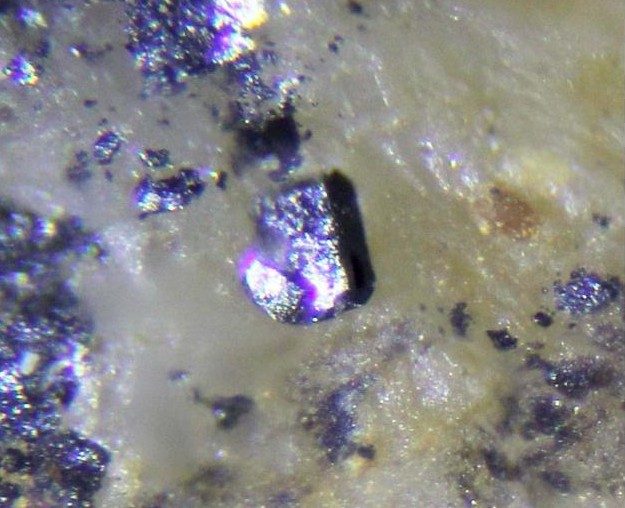
Black sharp crystals of the rare mineral graeserite from an Italian locality (Monte Arsiccio Mine, Sant'Anna di Stazzema, Stazzema, Lucca Province, Tuscany, Italy). Graeserite is named after the well known Swiss mineralogist expert on Lengenbach minerals Stefan Graeser. Ex. Erich Laskowski collection (USA). — Photo: David Hospital · CC BY 4.0
Graeserite
Graeserite is an IMA-recognized mineral species in the oxides & hydroxide class, with the chemical formula Fe³⁺₄Ti₃As³⁺O₁₃(OH).
It crystallizes in the monoclinic crystal system (space group C2/m).
Key properties: Mohs hardness 5.5; specific gravity 4.56; Black streak; Metallic luster.
IMA symbol Gsr, IMA status: approved, named in 1996.
Found in hydrothermal Alpine-type fissures (Switzerland).
It is found associated with Anatase, arsenopyrite, asbecasite, bournonite, cafarsite, cervandonite-(Ce), chernovite, fetiasite, gold (traces), hematite, magnetite, monazite-(Ce), rutile.
The mineral was named to honor Professor Stefan Graeser (b. 1935) of the Mineralogical-Petrographic Institute, University of Basel.