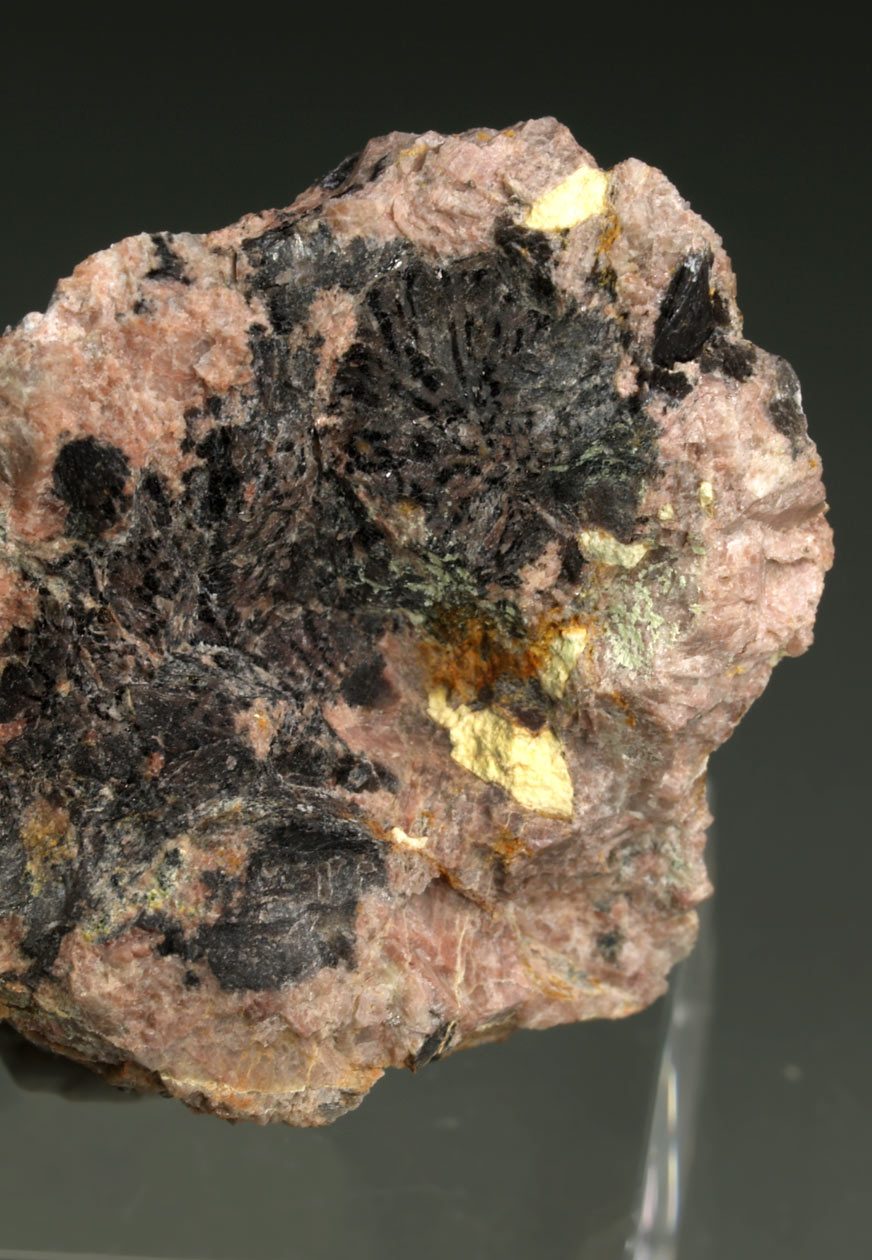
These specimens show yellowish nodules included in a feldspar matrix. First SEM-EDS analysis have yielded a phosphate of Th and Ca, with minor Pb. XRD has shown patterns of "bravantite", the old name for cheralite and brockite. The chemical base formula for these species are: grayite (Th,Pb,Ca)(PO4)·H2O; cheralite CaTh(PO4)2; brockite (Ca,Th,Ce)(PO4)·H2O. REE has not been found in EDS. We could say that this yellow nodules belongs from altered monazite, formed by mixed species cheralite-grayite, with minor brockite. Accompanied in matrix by meta-autunite. From: Brabant Farm 168, Karibib, Erongo, Namibia. Size: 5.3 × 3.7 × 3 cm. — Photo: Joan Rosell · CC BY-SA 4.0
Grayite
A thorium phosphate of the rhabdophane group discovered in 1957 in Rhodesia, usually in microgranular masses.
Intro adapted from Wikipedia (CC BY-SA).
Grayite is an IMA-recognized mineral species in the phosphate class, with the chemical formula (Th,Pb,Ca)(PO₄)·H₂O.
It is a member of the Rhabdophane structural group.
Key properties: Mohs hardness 3–4; specific gravity 3.7–4.3; Resinous to waxy luster.
IMA symbol Gry, grandfathered status — known before the IMA’s founding, named in 1957.
Found in a lithium-bearing pegmatite (Mtoko district, Zimbabwe); in an oxidized granitic vein in Precambrian rocks (Gunnison, Colorado, USA); in fracture fillings and disseminated through limestone (Fremont Co., Wyoming, USA).
It is found associated with Thorite (Mtoko district, Zimbabwe); monazite-(Ce), xenotime-(Y), zircon (Havey quarries, Maine, USA).
In honor of Anton Gray, mining engineer, advisor to the United Kingdom Atomic Energy Authority.