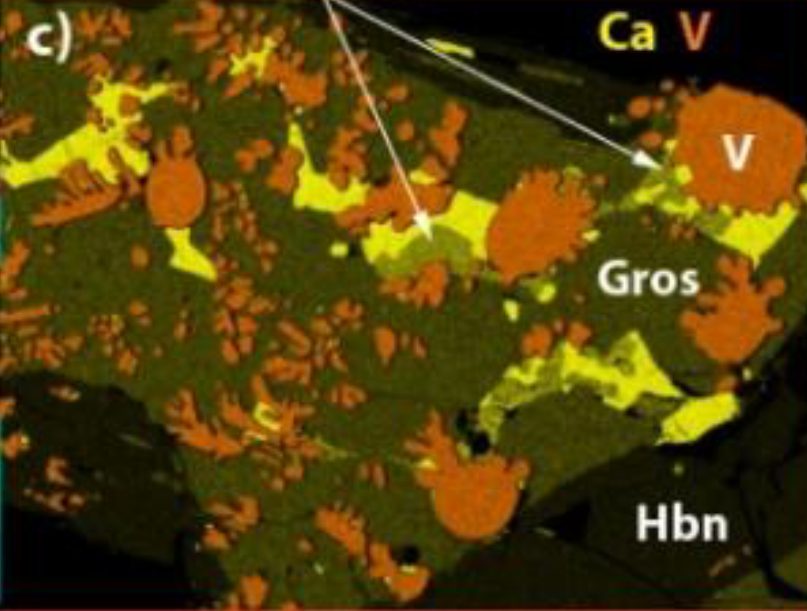
Images a the rock fragment from Mt Carmel. Back-scattered electron (BSE) image of the hibonite–grossite–spinel aggregate studied. The image is published in an open access article distributed under the terms and conditions of the Creative Commons Attribution (CC BY) license ( https://creativecommons.org/licenses/by/4.0/ ). — Photo: Bindi, Luca and Cámara, Fernando and Gain, Sarah E. M. and Griffin, William L. and Huang, Jin-Xiang and Saunders, Martin and Toledo, Vered · CC BY 4.0
Grossite
A colorless calcium-aluminium oxide described in 1994 from Israel's pyrometamorphic Hatrurim Formation.
Intro adapted from Wikipedia (CC BY-SA).
Grossite is an IMA-recognized mineral species in the oxides & hydroxide class, with the chemical formula CaAl₄O₇.
It crystallizes in the monoclinic crystal system (space group C2/c).
Key properties: specific gravity 2.88; White streak; Vitreous luster; refractive index 1.629; optically biaxial.
IMA symbol Gss, IMA status: approved, named in 1993.
Found in argillaceous limestones metamorphosed at high temperature and low pressure (Hatrurim Formation, Israel); in Ca–Al-rich inclusions thought formed by condensation from a hot gas or molten droplets (meteorites).
It is found associated with Brownmillerite, mayenite, larnite (Hatrurim Formation, Israel); perovskite, melilite, hibonite, spinel, calcian pyroxene (meteorites).
The mineral was named to honor Dr. Shulamit Gross (1923–), Geological Survey of Israel, Jerusalem, Israel, who noted the species in the Hatrurim Formation, Israel.