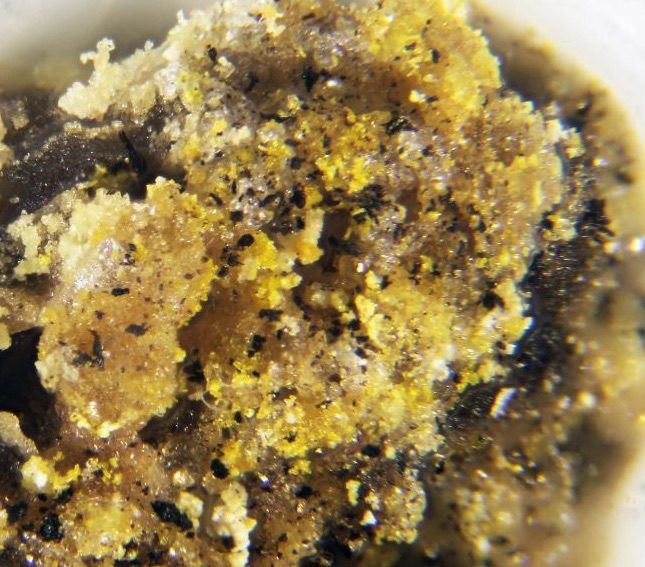
Yellow guanine crystals from the type locality (North Chincha Island, Pisco Province, Ica Department, Peru) and only one of the very few known localities worldwide. Original color of guanine is white but it darkens to yellow with exposure to light and time, as many organic compounds. Bodo Unger reported a new material that believed was xanthine in 1844. Einbrodt (1846) showed the identification was incorrect. Unger (1846) agreed, provided a full corrected description and named it guanine after the guano it was found in. Structural formula: NCHNHC2C(O)NHC(NH2)N. Aromatic heterocycle (an organic cyclic carbon compound with additional, non-carbon atom(s)); a nucleobase and an important constituent of both DNA and RNA. Ex Vandenbroucke Museum collection from Waregem, Belgium. — Photo: David Hospital · CC BY-SA 4.0
Guanine
An organic mineral — the same molecule as the DNA base — occurring in crystalline crusts in bird and bat guano deposits.
Intro adapted from Wikipedia (CC BY-SA).
Guanine is an IMA-recognized mineral species in the organic mineral class, with the chemical formula C₅H₃(NH₂)N₄O.
It crystallizes in the monoclinic crystal system (space group P2_1/n).
IMA symbol Gni, IMA status: approved, named in 1973.
An uncommon component of phosphatic crusts in association with guano from seabirds or bats.
It is found associated with Aphthitalite, biphosphammite, brushite, gypsum, monetite, syngenite, taylorite, hannayite (Murra-el-elevyn Cave, Australia); biphosphammite, archerite.
The name comes from the Peruvian guanu, for dung, in allusion to its mode of formation in nature.