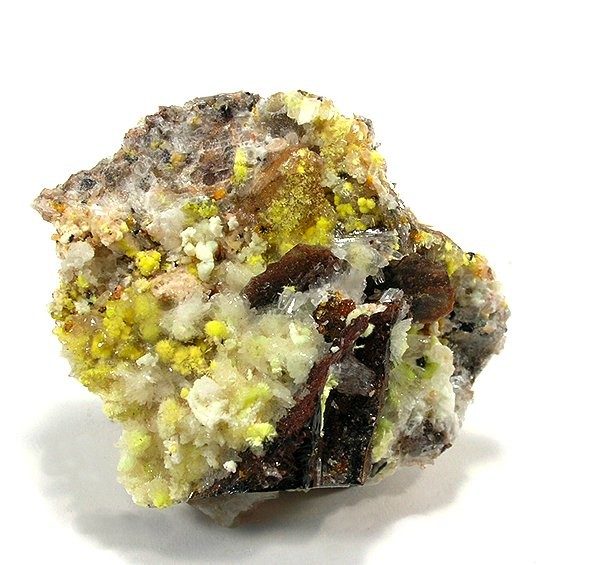
Haiweeite , Gypsum (Var.: Gypsum ) Locality: Perus, São Paulo , São Paulo , Southeast Region, Brazil ( Locality at mindat.org ) Size: 6.5 x 5.6 x 1.9 cm. Haiweeite is one of the more attractive of the non-African suite of radioactives containing uranium, and remains a rarity known in good crystals from but a few locales. This is a very rare, hydrated, calcium, uranium, silicate. Extremely colorful and rarely ever seen in dealers stocks. This is a large and rich specimen of the material. It came out about 6 years ago. Tim Blackwood Collection. — Photo: Robert M. Lavinsky · CC BY-SA 3.0
Haiweeite
A greenish-yellow hydrated calcium uranyl silicate — a secondary uranium oxidation product.
Intro adapted from Wikipedia (CC BY-SA).
Haiweeite is an IMA-recognized mineral species in the silicate class, with the chemical formula Ca(UO₂)₂(Si₅O₁₂)(OH)₂·6H₂O.
It crystallizes in the orthorhombic crystal system (space group Pbcn).
Key properties: Mohs hardness 3.5; specific gravity 3.35; Pearly on the cleavage luster; optically biaxial.
IMA symbol Hwe, IMA status: approved, named in 1959.
On fracture surfaces in granite and in voids in neighboring loosely consolidated lake bed sediments (Coso Mountains, California, USA); along fractures in tourmaline-bearing granite and granite pegmatite (Brazil).
It is found associated with Autunite, meta-autunite, uranophane, uranophane-beta, phosphuranylite, torbernite, meta-torbernite, chernikovite, uranian “opal" (Perus, Brazil).
The name refers to the Haiwee Reservoir, Coso Mountains, California, USA, above which the mineral was first found to occur.