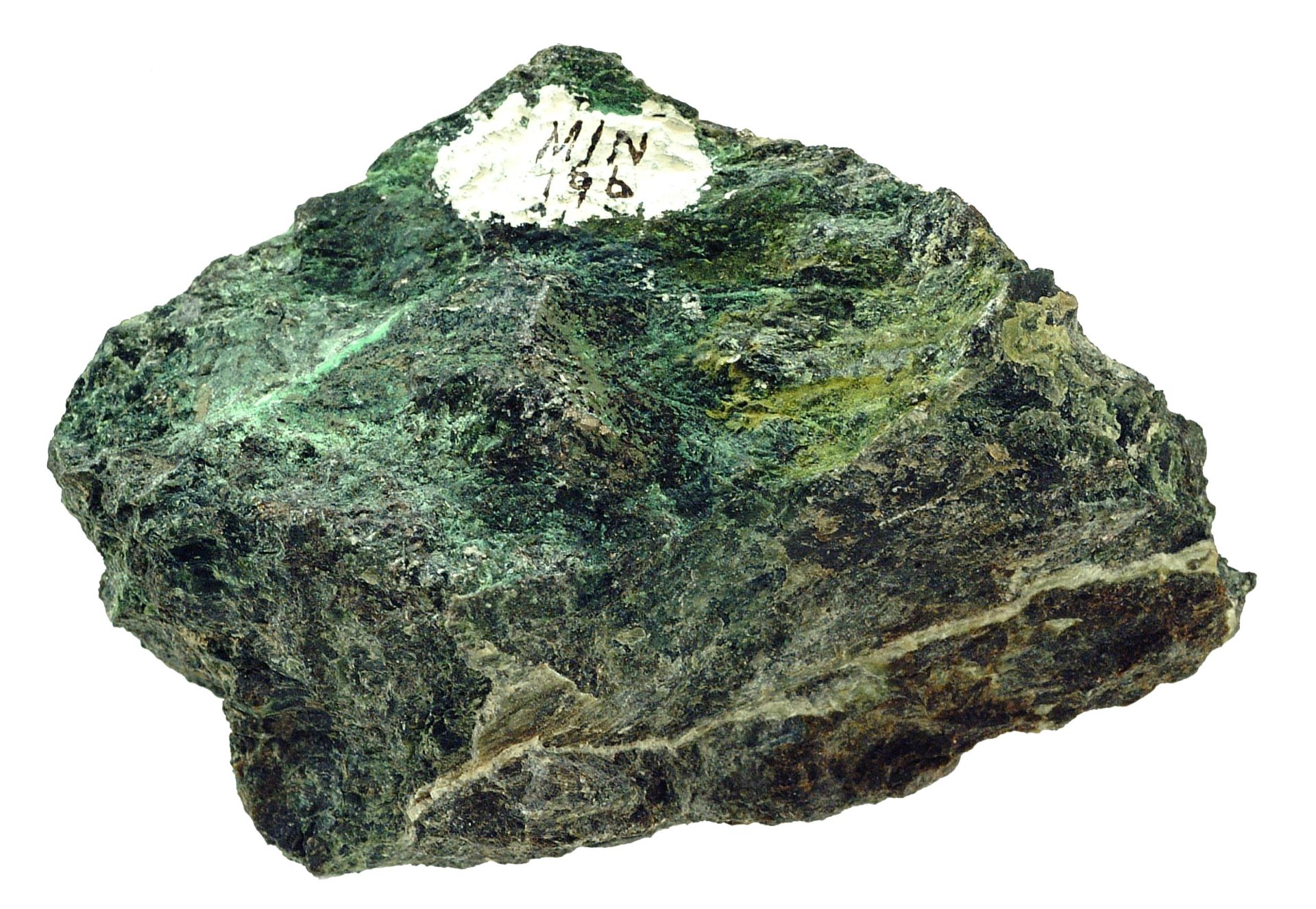
This specimen is dominated by green serpentine, but it also contains heazlewoodite, Ni3S2 (brownish-gray and fine grained), a rare mineral. It coes from Heazlewood, the type localitiy in Tasmania. The specimen is about 9 cm across. — Photo: Darla Sondrol · CC0
Heazlewoodite
A rare sulfur-poor nickel sulfide forming brassy-bronze grains in serpentinized dunite.
Intro adapted from Wikipedia (CC BY-SA).
Heazlewoodite is an IMA-recognized mineral species in the sulfide class, with the chemical formula Ni₃S₂.
It crystallizes in the trigonal crystal system (space group R32).
Key properties: Mohs hardness 4; specific gravity 5.82; Metallic. Anisotropism: Strong, brown to bluish gray. R1 –R2: (400) 24.0–25.4, (420) 31.2–31.9, (440) 38.2–38.5 luster.
IMA symbol Hzl, grandfathered status — known before the IMA’s founding, named in 1897.
Found in serpentinized dunites and lherzolites, and in ophiolites, probably of hydrothermal origin; in layered mafic intrusives nd chromitites, where it may be a low-temperature secondary mineral; in mantle xenoliths.
It is found associated with Pentlandite, chalcopyrite, violarite, cubanite, millerite, mackinawite, orcelite, zaratite, shandite, awaruite, platinum group minerals, magnetite, chromite.
The name is derived from the locality near Heazlewood, Tasmania, Australia.