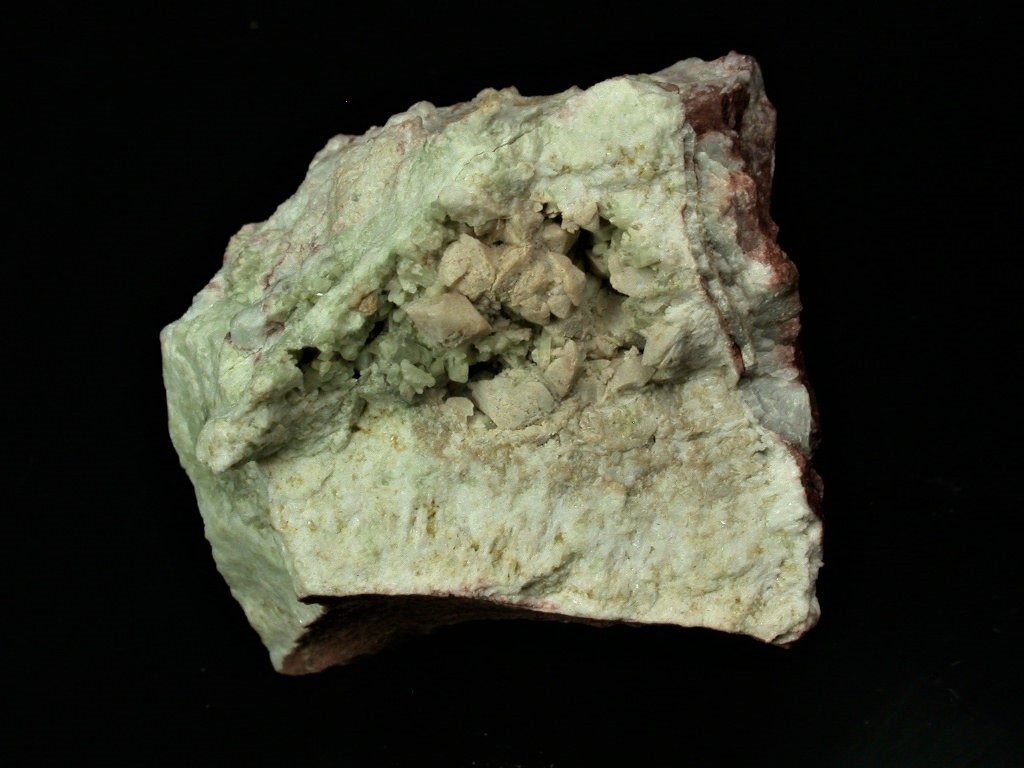
Hedyphane , Austinite Dimensions: 35 mm x 28 mm x 25 mm Locality: Beltana Mine (E.Z. Mine; Beltana deposit; Beltana-Aroona deposit; Puttapa mine), Puttapa, Leigh Creek, North Flinders Ranges, Flinders Ranges, South Australia, Australia Vug of white Hedyphane and smaller Austinite crystals in massive white Hedyphane. Acquired from Peter Elliott in 2017. JSS specimen and photo. — Photo: John Sobolewski (JSS) · CC BY 3.0
Hedyphane
Hedyphane is an IMA-recognized mineral species in the arsenate class, with the chemical formula Ca₂Pb₃(AsO₄)₃Cl.
It crystallizes in the hexagonal crystal system (space group P6_3/m). It is a member of the Apatite structural group.
Key properties: Mohs hardness 4.5; specific gravity 5.71–5.85; White streak; Vitreous to greasy luster; optically uniaxial.
IMA symbol Hdp, IMA status: approved, named in 1830.
Found as a rare secondary mineral in metamorphosed manganese deposits (Sweden); in a metamorphosed stratiform zinc orebody (Franklin, New Jersey, USA).
It is found associated with Barite, barylite, rhodonite, hausmannite, bixbyite, phlogopite, amphibole, calcite (Långban, Sweden); barylite, calcite, copper, rhodonite, barite.
Its name comes from the Greek for beautifully bright, in allusion to the typical luster of specimens.