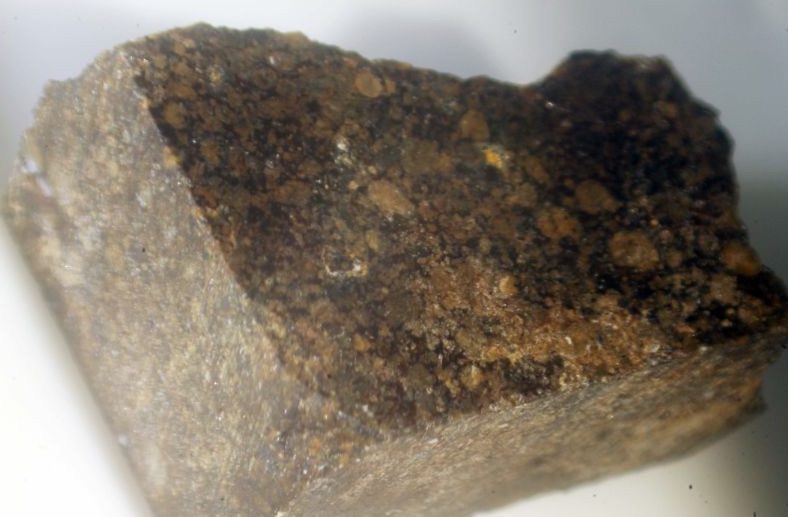
Metallic spots of the extremely rare Fe-Cr-Ti sulphide mineral heideite from the type locality in Bustea, India (Bustee Meteorite, Gorakhpur, Basti District, Uttar Pradesh, India). Heideite is a mineral found only in very few meteorites, specifically three (Bustee meteorite, Sahara meteorite and Kaidun meteorite) and in a fourth locality under the Pacific ocean. Specimen analyzed by the former owner of the specimen (the Vandenbroucke Museum). Four of the six faces were polished because of the analysis. The mineral has a creamywhite color in reflected light and has moderately strong reflection birefringence ranging from purple gray to cream gray. Ex Vandenbroucke Museum collection from Waregem, Belgium. — Photo: David Hospital · CC BY-SA 4.0
Heideite
Heideite is an IMA-recognized mineral species in the sulfide class, with the chemical formula (Fe,Cr)₁.₁₅(Ti,Fe)₂S₄.
It crystallizes in the monoclinic crystal system (space group I2/m). It is a member of the Wilkmanite structural group.
Key properties: Mohs hardness 3.5–4.5; specific gravity 3.942.
IMA symbol Hei, IMA status: approved, named in 1973.
Occurs as minute anhedral grains (Bustee meteorite).
It is found associated with Titanian troilite, ferroan alabandite, daubréelite, oldhamite, osbornite, niningerite, forsterite, iron (Bustee meteorite).
The mineral was named to honor Professor Fritz Heide (1891–1973), meteoriticist of Jena, Germany.