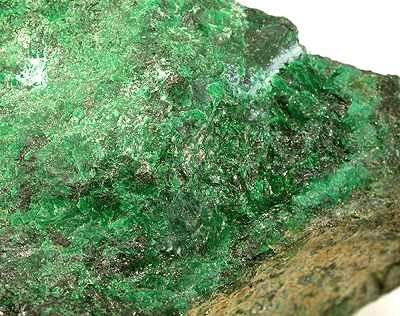
Hellyerite , Heazlewoodite , Zaratite Locality: Lord Brassey Mine, Heazlewood district, Tasmania , Australia ( Locality at mindat.org ) Size: 10.4 x 7.8 x 4.4 cm. A very rich, very rare and fine cabinet specimen from Tasmania. The rich, emerald-green coating of the rare nickel carbonate, zaratite, hosts powder-blue hellyerite and light bronze heazlewoodite. Hellyerite is a rare nickel carbonate and heazlewoodite is a rare nickel sulfide and the Lord Brassey Mine is the Type Locality for both species. The matrix also contains chromite. The Lord Brassey mine is an old abandoned nickel mine. You do not see much available. Older, exceptionally rich and rare combination material. — Photo: Robert M. Lavinsky · CC BY-SA 3.0
Hellyerite
A pale-blue to bright-green hydrated nickel carbonate from Tasmania's Hellyer mine.
Intro adapted from Wikipedia (CC BY-SA).
Hellyerite is an IMA-recognized mineral species in the carbonate class, with the chemical formula Ni(CO₃)·6H₂O.
Key properties: Mohs hardness 2.5; specific gravity 1.97; Vitreous luster; optically biaxial.
IMA symbol Hy, IMA status: approved, named in 1959.
Very rare, as coatings on shear surfaces in serpentinite.
It is found associated with Zaratite, theophrastite, otwayite.
The mineral was named to honor Henry Hellyer (1791–1832), first Surveyor-General of the Van Diemen’s Land Company and explorer of northwestern Tasmania.