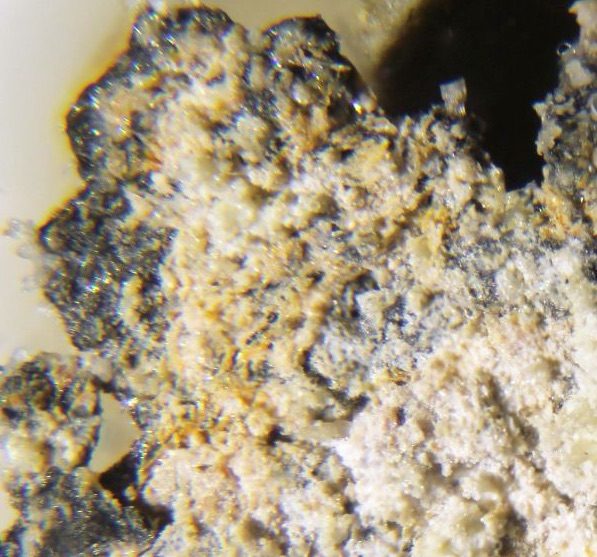
Orange crystal aggregates of the very rare Pb-Fe oxide -hydroxide mineral hematophanite from one of the only 3 known localities worldwide: Richelsdorf District, Wildeck, Hesse, Germany. Ex Vandenbroucke Museum collection from Waregem, Belgium. — Photo: David Hospital · CC BY-SA 4.0
Hematophanite
Hematophanite is an IMA-recognized mineral species in the halide class, with the chemical formula Pb₄Fe³⁺₃O₈(Cl,OH).
It crystallizes in the tetragonal crystal system (space group P4mm). It is a member of the Perovskite structural group.
Key properties: Mohs hardness 2–3; specific gravity 7.7; Orange streak; Submetallic luster; optically uniaxial.
IMA symbol Hph, grandfathered status — known before the IMA’s founding, named in 1928.
Found in a metamorphosed banded Fe–Mn ore deposit in dolostone (Jakobsberg, Sweden).
It is found associated with Plumboferrite, jacobsite, andradite, copper, cuprite, cerussite, calcite (Jakobsberg, Sweden); copper, jacobsite, hematite, damaraite (Kombat mine, Namibia).
Its name comes from the Greek for blood and visible, presumably for the blood-red color exhibited in transmitted light.