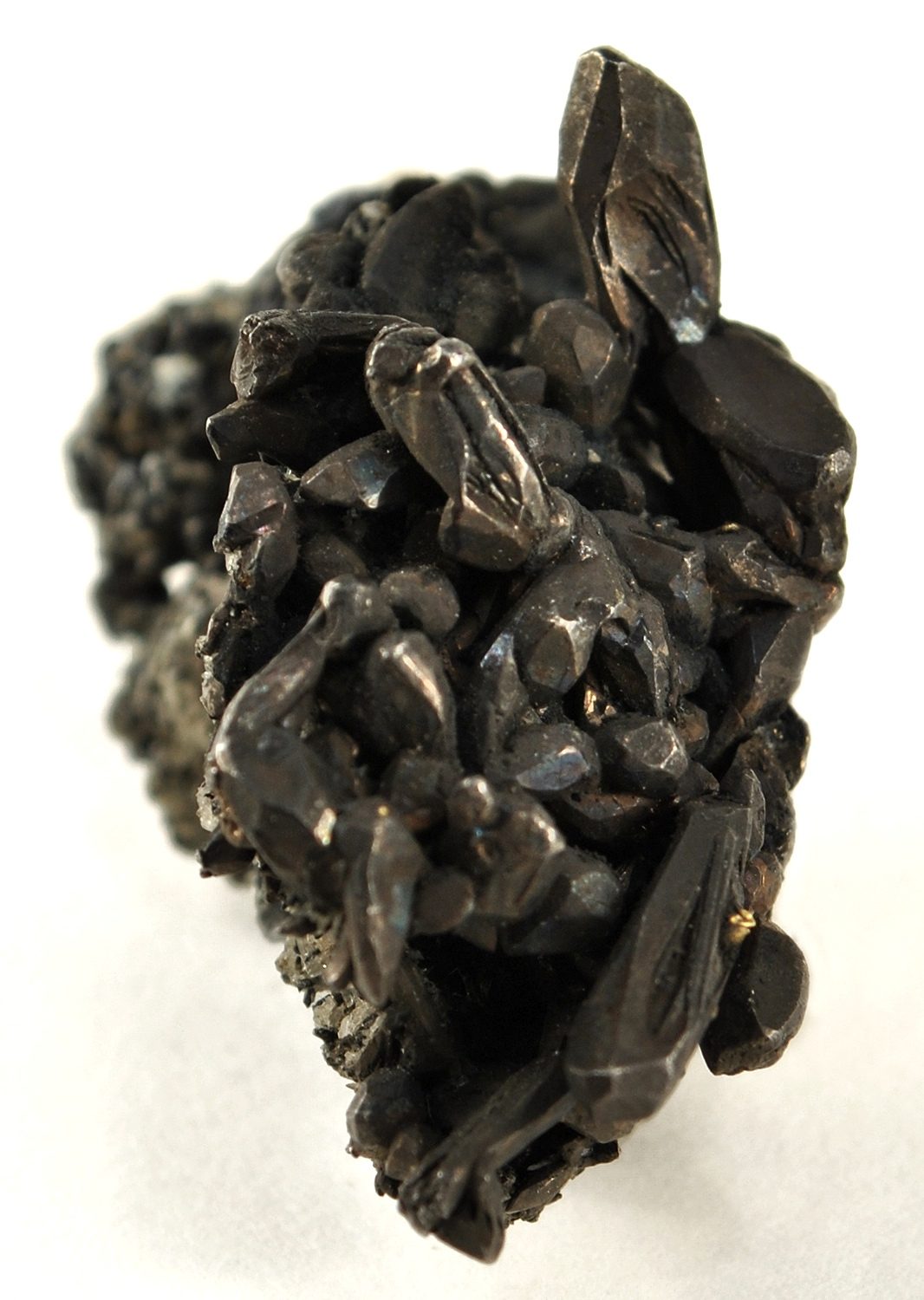
Hessite Locality: Botés, Alba County , Romania ( Locality at mindat.org ) Size: miniature, 3.5 x 2.5 x 1.2 cm Hessite An exceptional miniature with robust, spiky hessite crystals shooting out from a common core. This is classic type locality material, now hard to come by in good specimens! It is from the American Museum of Natural History in NYC, and note the early accession number #831, dating it to the 1800's. Anyways, most were mined by 1900, as well. With sharp crystals to nearly 1 cm, this is a choice example for the sizer and price range. The piece also has its original patina, and is not cleaned with acid, as you can tell by the associated calcite crystals in crevasses. Ex Lawrence Conklin collection, obtained in trade from the American Museum of Natural History. You can see it displays either horizontally or vertically — Photo: Robert M. Lavinsky · CC BY-SA 3.0
Hessite
Silver telluride — a soft dark-gray monoclinic mineral named for chemist Germain Henri Hess.
Intro adapted from Wikipedia (CC BY-SA).
Hessite is an IMA-recognized mineral species in the sulfide class, with the chemical formula Ag₂Te.
It crystallizes in the monoclinic crystal system (space group P2_1/c).
Key properties: Mohs hardness 2–3; specific gravity 8.24–8.45; lead-gray streak; Metallic. Anisotropism: Distinct, from dark orange to dark blue. R1 –R2: (400) 40.7–42.6, (420) 40.3–41.8 luster.
IMA symbol Hes, grandfathered status — known before the IMA’s founding, named in 1843.
Found in hydrothermal medium- and low-temperature veins; also in small quantities in some massive pyrite deposits.
It is found associated with Calaverite, sylvanite, altaite, petzite, empressite, rickardite, gold, tellurium, pyrite, galena, tetrahedrite, chalcopyrite.
The mineral was named to honor Germain Henri Hess (1802–1850), Swiss-Russian physician and chemist, of St. Petersburg, Russia.