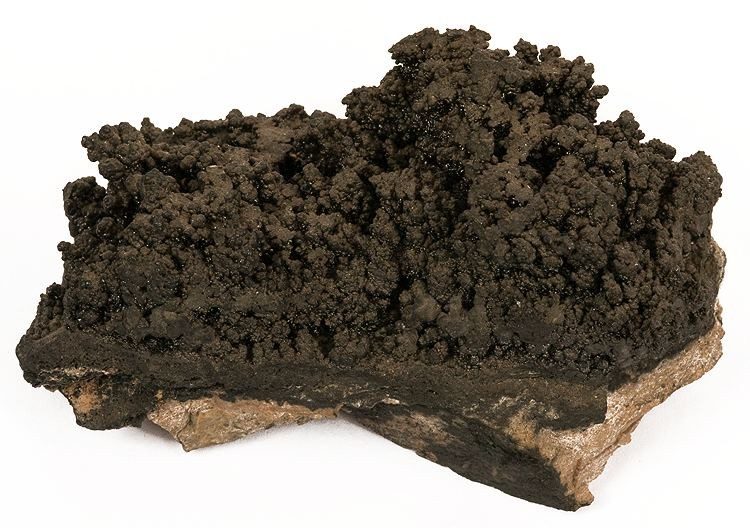
Hetaerolite Locality: Campbell Mine (Campbell shaft), Bisbee , Warren District , Mule Mts, Cochise County , Arizona , USA ( Locality at mindat.org ) Size: 8.3 x 4.4 x 4.2 cm. Little-known hetaerolite is a secondary mineral associated with other manganese minerals, primarily in hydrothermal ore deposits. Interestingly, its type locality is Franklin, the only locality that could rival Bisbee (where this is from) as "the" great American mineral locality. This is an extremely rich specimen, with the hetaerolite piled up in stalactitic form 2.5 cm thick on the matrix. Ex. Dave Stoudt collection, and in an older collection before that in the early 1950s. But the specimen may be much, much older. From the 1900 Level. — Photo: Robert M. Lavinsky · CC BY-SA 3.0
Hetaerolite
Hetaerolite is an IMA-recognized mineral species in the oxides & hydroxide class, with the chemical formula ZnMn³⁺₂O₄.
It crystallizes in the tetragonal crystal system (space group I4_1/amd). It is a member of the Spinel structural group.
Key properties: Mohs hardness 6; specific gravity 5.18; Dark brown streak; Metallic to submetallic luster; optically uniaxial.
IMA symbol Hta, grandfathered status — known before the IMA’s founding, named in 1877.
A secondary mineral in association with other manganese minerals, primarily in hydrothermal ore deposits.
It is found associated with Franklinite, chalcophanite, hodgkinsonite, willemite, hemimorphite, manganite, romanechite, calcite.
Its name comes from the Greek for companion, for its occasional association with chalcophanite.