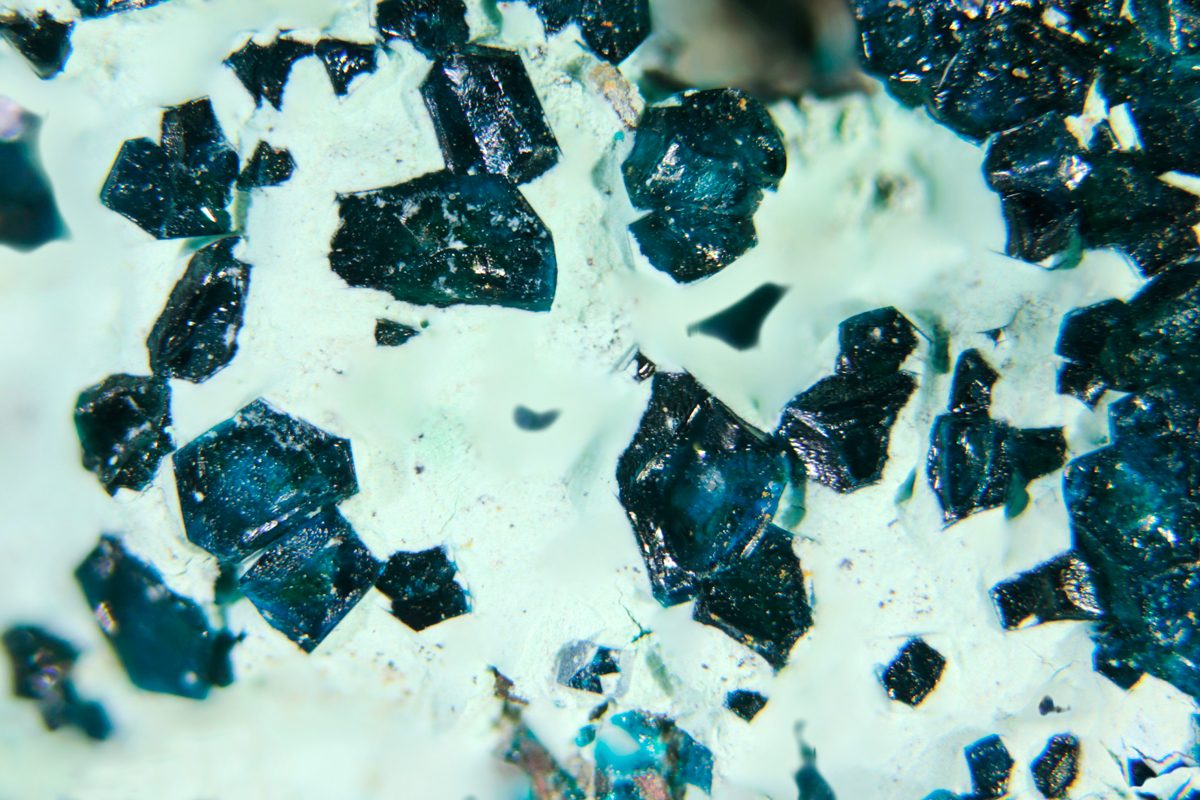
Hoganite specimens we have studied form tabular to equant pseudohexagonal crystals; some of them with something similar to rhombohedron faces. Transparent to translucent, with good brilliance and curved faces and edges. Determined by Raman spectroscopy and SEM-EDS. They are disposed on the copper and "limonite" matrix and accompanied by light green globular aggregates of a unidentified copper chloride similar to atacamite. These chloride is partially covering hoganite crystals. The origin of these hoganite crystals is not completely known. "Natural" hoganite specimens are formed, as we said before, from decomposing vegetable matter, like leaves or mine wooden beams. But in this case, we propose that these crystals could be formed, in dry conditions, from acids (vinegar) and solutions, those miners are using to clean native copper specimens. But the presence of the copper chloride covering hoganite is a point to investigate. Locality: Oumjrane Mines, Alnif, Meknès-Tafilalet Region, Morocco Size: 3.7 × 3.2 × 2.5 cm — Photo: Joan Rosell , from rosellminerals.com · CC BY-SA 4.0
Hoganite
Hoganite is an IMA-recognized mineral species in the organic mineral class, with the chemical formula Cu(CH₃COO)₂·H₂O.
It crystallizes in the monoclinic crystal system (space group C2/c). It is a member of the Acetate structural group.
Key properties: Mohs hardness 1.5; specific gravity 1.91; Pale blue streak; Vitreous luster; optically biaxial.
IMA symbol Hgn, IMA status: approved, named in 2001.
Formed in ferruginous gossan by reaction of oxidized zone metallic minerals with decaying vegetable matter provided by leaf litter and possibly mine timbers.
It is found associated with Paceite, linarite, malachite, azurite, cuprian smithsonite, cerussite, goethite, hematite, quartz.
The mineral was named to honor Graham P. Hogan (1957–), Broken Hill, Australia, miner and collector of Broken Hill minerals, who found the first specimens.