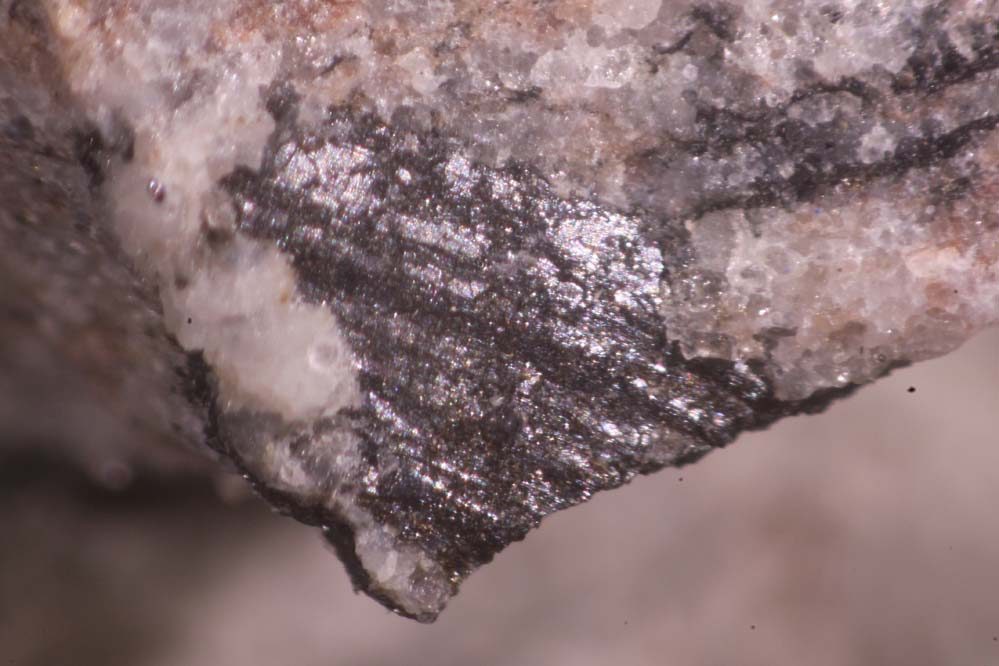
Black crystals of the very rare mineral hogtuvaite from the type and only locality known worldwide (Hogtuva, Rana, Nordland, Norway). Hogtuvaite is a complex beryllium silicate. — Photo: David Hospital · CC BY-SA 4.0
Høgtuvaite
Høgtuvaite is an IMA-recognized mineral species in the silicate class, with the chemical formula Ca₄[Fe²⁺₆Fe³⁺₆]O₄[Si₈Be₂Al₂O₃₆].
It crystallizes in the triclinic crystal system (space group P-1). It is a member of the Sapphirine structural group.
Key properties: Mohs hardness 5.5; specific gravity 3.85–3.88; Dark green streak; Subadamantine to nonmetallic luster; optically biaxial.
IMA symbol Htu, IMA status: approved, named in 1990.
Found as a late-stage metamorphic mineral in peraluminous granitic gneisses and mafic pegmatites in association with a beryllium deposit (near Mo i Rana, Norway).
It is found associated with Quartz, albite, microcline, biotite, phenakite, zircon, fluorite, calcite, many minor beryllium and sulfide minerals (near Mo i Rana, Norway).
The name refers to H¿gtuva Mountain, near the type locality in Norway.