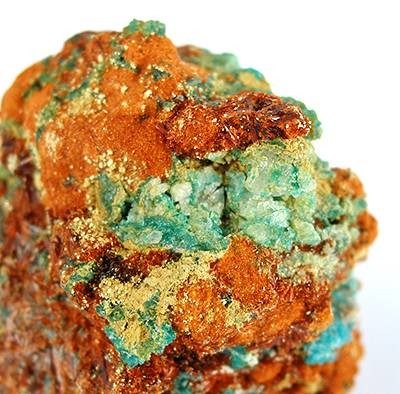
Amarantite , Hohmannite Locality: Queténa Mine, Toki Cu deposit, Chuquicamata District, Calama , El Loa Province , Antofagasta Region , Chile ( Locality at mindat.org ) Size: 3.9 x 3.9 x 2.3 cm. Two beautiful orange iron-containing minerals, both very rare, richly presented on one specimen! The piece shows sharp, flat-laying, acicular crystals of Amarantite in sprays to perhaps 5mm. In person, these crystals have a robust, electric orange-red flare to them and are quite eye-visible. Mixed in (close-up photo) are small tufts or ball-shaped clusters of microcrystalline Hohmannite. Associated minerals are Metahohmannite, Kornelite , Chalcanthite, Copiapite, and Picromerite, I am told. — Photo: Robert M. Lavinsky · CC BY-SA 3.0
Hohmannite
Hohmannite is an IMA-recognized mineral species in the sulfate class, with the chemical formula Fe³⁺₂O(SO₄)₂·8H₂O.
It crystallizes in the triclinic crystal system (space group P-1). It is a member of the Amarantite structural group.
Key properties: Mohs hardness 3; specific gravity 2.255; Yellow-orange streak; Vitreous, brilliant luster; optically biaxial.
IMA symbol Hoh, grandfathered status — known before the IMA’s founding, named in 1888.
An uncommon low-temperature precipitate in oxidized iron sulfide deposits.
It is found associated with Metahohmannite, copiapite, amarantite, sideronatrite (Sierra Gorda district, Chile); chalcanthite, picromerite, amarantite, fibroferrite.
The mineral was named to honor Thomas Hohmann (1843–1897), mining engineer of Valparaiso, Chile who discovered the first specimens.