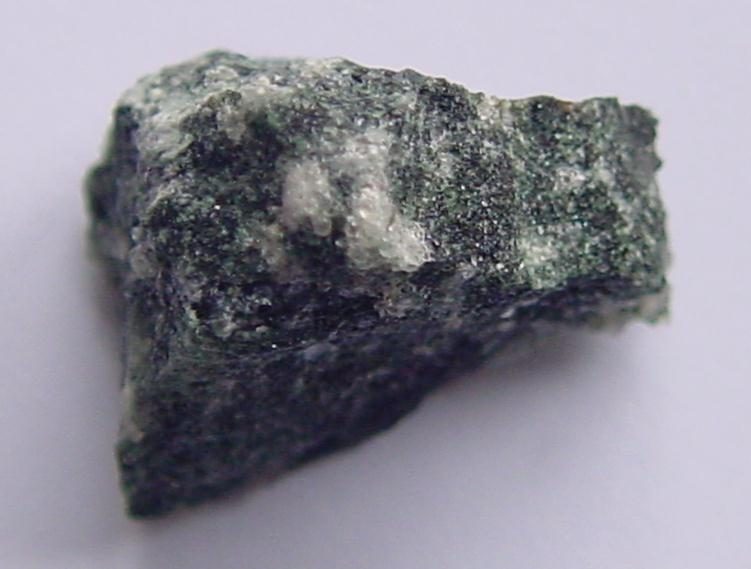
Hsianghualite, white, from Xianghualing, Hunan Province, China. Specimen size 1.5 cm — Photo: Strickja · Public domain
Hsianghualite
A lithium-calcium-beryllium zeolite named for the Xianghualing ('fragrant flower') locality in China.
Intro adapted from Wikipedia (CC BY-SA).
Hsianghualite is an IMA-recognized mineral species in the silicate class, with the chemical formula Li₂Ca₃Be₃(SiO₄)₃F₂.
It crystallizes in the cubic crystal system (space group I2_13). It is a member of the Analcime structural group.
Key properties: Mohs hardness 6.5; specific gravity 2.97; Vitreous luster; refractive index 1.613.
IMA symbol Hsi, IMA status: approved, named in 1958.
Found in phlogopite veins in a fluorine-rich metamorphosed Devonian limestone intruded by a beryllium-bearing granite.
It is found associated with Fluorite, zinnwaldite, chrysoberyl, taaffeite, liberite.
The name refers to the place of discovery; the word means fragrant flower in Chinese.