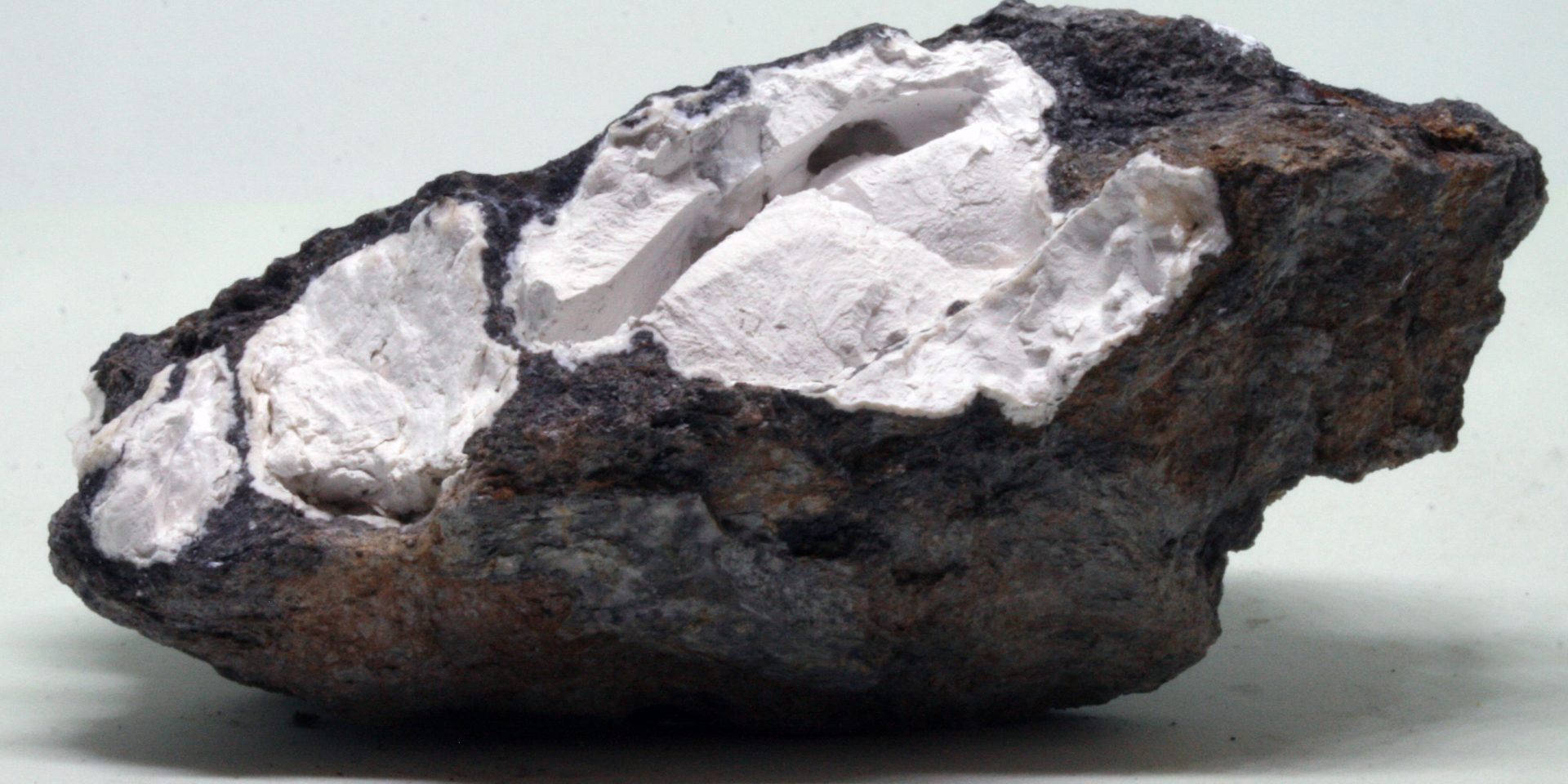
Huntite nodules. Turó de Montcada quarry, Montcada y Reixac, Barcelona, Spain — Photo: Bergminer · CC BY-SA 4.0
Huntite
A magnesium-calcium carbonate forming platy trigonal crystals — used since antiquity as a white pigment.
Intro adapted from Wikipedia (CC BY-SA).
Huntite is an IMA-recognized mineral species in the carbonate class, with the chemical formula CaMg₃(CO₃)₄.
It crystallizes in the hexagonal crystal system (space group R32).
Key properties: Mohs hardness 3; specific gravity 2.696; White streak; Dull luster; refractive index 1.619; optically uniaxial.
IMA symbol Hun, grandfathered status — known before the IMA’s founding, named in 1953.
Filling vugs and coating fractures in rock; as flowstone and incrustations in caves; typically precipitated by evaporative concentration of meteoric solutions weathering magnesite- or dolomite-bearing rocks, or serpentinites and ophiolites.
It is found associated with Magnesite, dolomite, aragonite, calcite, hydromagnesite.
The mineral was named to honor Professor Walter Frederick Hunt (1882–1975), University of Michigan, Ann Arbor, Michigan, USA, and chemist with the U.S. Geological Survey.