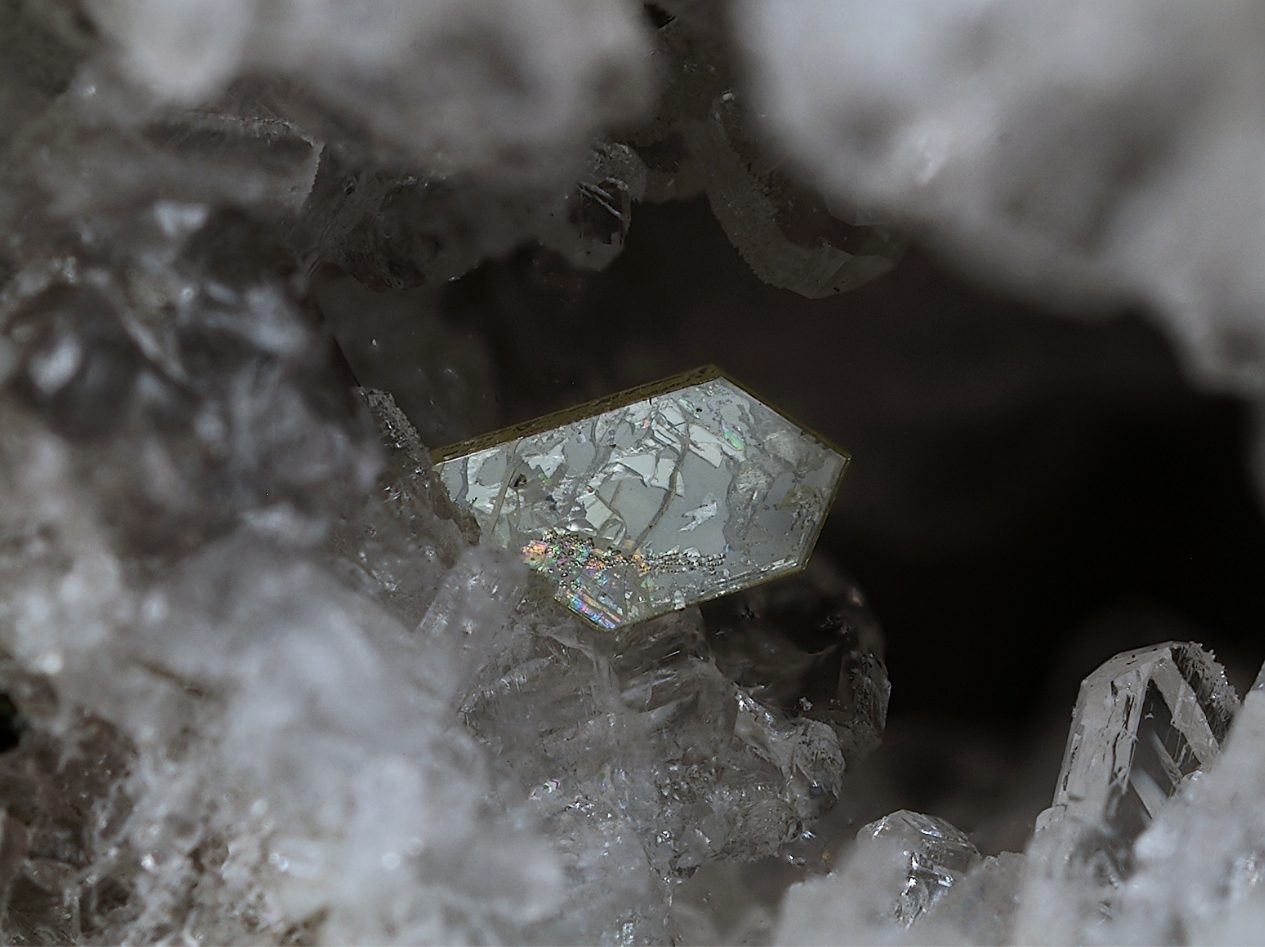
Huttonite (Field of view: 3.0 mm) Locality: Laacher See Volcanic Complex, Volcanic Eifel, Rhineland-Palatinate, Germany Description: Huttonite crystal from the Laacher See volcanic complex. Collection: Karl Leu. Photo: Fred Kruijen — Photo: Fred Kruijen · CC BY-SA 3.0 nl
Huttonite
The monoclinic form of thorium silicate — dimorphous with tetragonal thorite and isostructural with monazite.
Intro adapted from Wikipedia (CC BY-SA).
Huttonite is an IMA-recognized mineral species in the silicate class, with the chemical formula Th(SiO₄).
It crystallizes in the monoclinic crystal system (space group P2_1/n). It is a member of the Monazite structural group.
Key properties: Mohs hardness 4.5; specific gravity 7.1; refractive index 1.907; optically biaxial.
IMA symbol Ht, grandfathered status — known before the IMA’s founding, named in 1951.
Found in beach sands (New Zealand).
It is found associated with Scheelite, titanian cassiterite, uranothorite, ilmenite, gold (New Zealand); cheralite, thorogummite, thorian ningyoite (Bogatynia area, Poland).
The name refers to Colin Osborne Hutton (1910–1971), New Zealand-American mineralogist of Stanford University, Palo Alto, California, USA. All rights reserved.