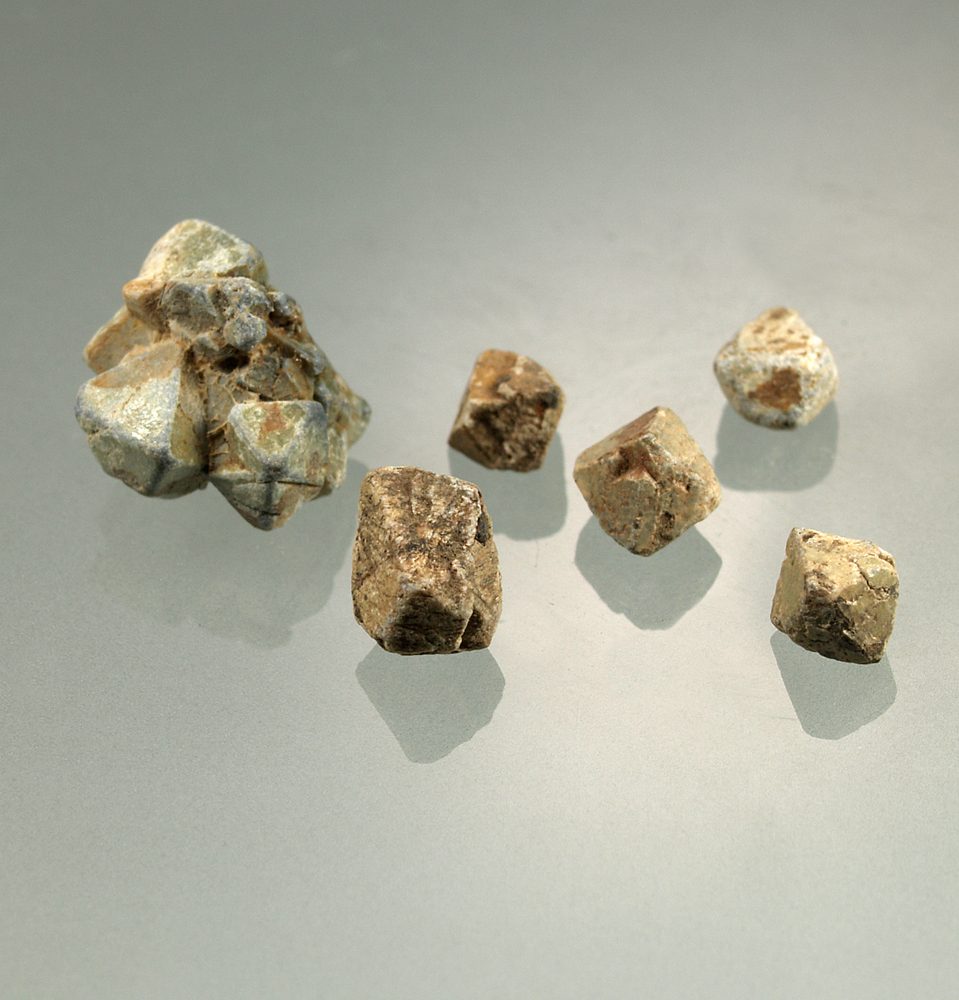
:Locality: Lueshe Mine, Kivu, DR Congo Size: 0.9 × 0.7 × 0.6 cm Description: One inter-grown group of hydropyrochlore crystals and some isolated crystals, from the Lueshe Mine the Type Locality for the species. The former species from the Lueshe carbonatite was named "kalipyrochlore" (described in 1965, named in 1977), but it was renamed as hydropyrochlore by new nomenclature (2010, 2013). — Photo: Joan Rosell , from rosellminerals.com · CC BY-SA 4.0
Hydropyrochlore
The hydrated, vacancy-dominant member of the pyrochlore group — a niobium oxide where water and empty sites replace some cations.
Intro adapted from Wikipedia (CC BY-SA).
Hydropyrochlore is an IMA-recognized mineral species in the oxides & hydroxide class, with the chemical formula (H₂O, )₂Nb₂(O,OH)₆(H₂O).
It crystallizes in the cubic crystal system (space group Fd3m). It is a member of the Pyrochlore-Pyrochlore structural group.
Key properties: Mohs hardness 4–4.5; specific gravity 3.4–3.48; [Vitreous to resinous.] luster.
IMA symbol Hpcl, IMA status: approved, named in 1977.
Found in alluvial deposits and residual soils from a carbonatite deposit, formed from pyrochlore by the leaching of Na, Ca, and F in waters rich in K ions.
It is found associated with Na-Ca pyrochlores, lueshite, columbite, fersmite, ilmenite, rutile, barian goyazite.
The name refers to a member of the pyrochlore group with a prefix to indicate dominant H2O (hydro) in the Y site and in the A site. Formerly ‘kalipyrochlore’, now redefined.