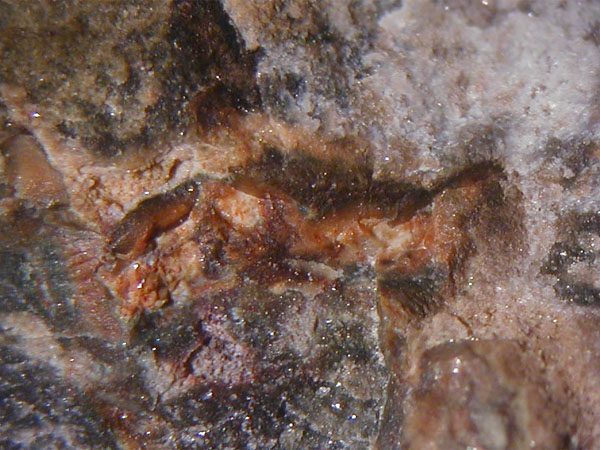
Ye'elimite (white) intergrown with Hydroxylellestadite (reddish-brown) in grey Anhydrite (Picture size 6 mm) Locality: Ronneburg, Thuringia, Germany — Photo: Thomas Witzke · CC BY-SA 3.0 de
Hydroxylellestadite
The hydroxyl analogue of fluorellestadite — a rare apatite-group calcium nesosilicate with sulfate.
Intro adapted from Wikipedia (CC BY-SA).
Hydroxylellestadite is an IMA-recognized mineral species in the silicate class, with the chemical formula Ca₅(SiO₄)₁.₅(SO₄)₁.₅OH.
It crystallizes in the hexagonal crystal system (space group P6_3/m). It is a member of the Apatite structural group.
Key properties: Mohs hardness 4.5; specific gravity 3.068; White streak; Vitreous luster; optically uniaxial.
IMA symbol Hel, IMA status: approved, named in 1937.
Found in contact metamorphosed limestone (Crestmore). In highly phosphatized, silicate- rich, carbonate-mudstone cave sediments heavily compacted and thermally transformed by in situ combustion of bat guano (Romania).
It is found associated with Diopside, wollastonite, vesuvianite, monticellite, okenite, calcite (Crestmore); berlinite (Cioclovina Cave); wilkeite, apatite, magnetite, chlorite.
The mineral was named to honor Dr. Reuben B. Ellestad (1900-1993), American analytical chemist, University of Minnesota, Minneapolis, Minnesota, USA.