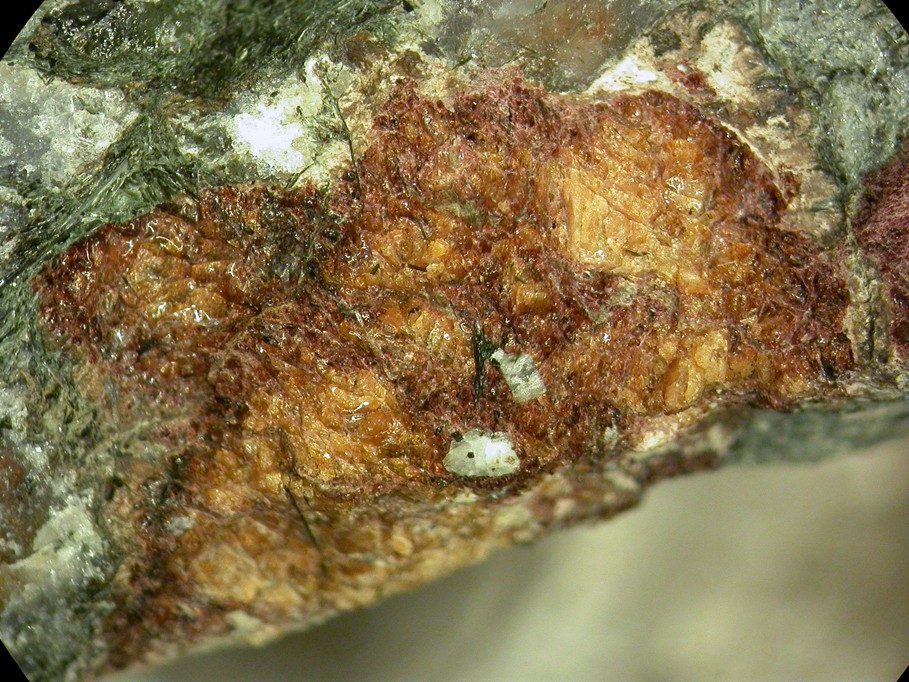
Ikranite , Aegirine (FOV is ~ 13 x 11 mm) Locality: Karnasurt Mt, Lovozero Massif, Kola Peninsula, Murmanskaja Oblast, Northern Region, Russia Original description: Brownish-yellow Ikranite grain in fibrous Aegirine-III aggregate from axial zone of nepheline-syenite pegmatite. The grain contain brownish-red to violet-red zones of alteration, composed by apparently new specie - oxi-variety of Ikranite. Holotype specimen - part of the single known boulder, find on dumps of Karnasurt mine. Collected by Nikita V. Chukanov. Pavel M. Kartashov collection and specimen. — Photo: Pavel M. Kartashov · CC BY-SA 3.0 de
Ikranite
A trigonal eudialyte-group cyclosilicate named for the Russian Academy of Sciences' Shubinov Institute of Crystallography.
Intro adapted from Wikipedia (CC BY-SA).
Ikranite is an IMA-recognized mineral species in the silicate class, with the chemical formula (Na,H₃O)₁₅(Ca,Mn,REE)₆Fe³⁺₂Zr₃Si₂₄O₆₆(O,OH)₆Cl·nH₂O.
It crystallizes in the hexagonal crystal system (space group R3m). It is a member of the Eudialyte structural group.
Key properties: Mohs hardness 5; specific gravity 2.82; White streak; Vitreous luster; optically uniaxial.
IMA symbol Ikr, IMA status: approved, named in 2000.
Found in an agpaitic pegmatite in an alkaline igneous complex.
It is found associated with Aegirine, microcline, lorenzenite, nepheline, lamprophyllite, murmanite, arfvedsonite.
The name comes from the Russian acronym IKRAN, for the Institut Kristallografii Rossiiskoy Akademii Nauk.