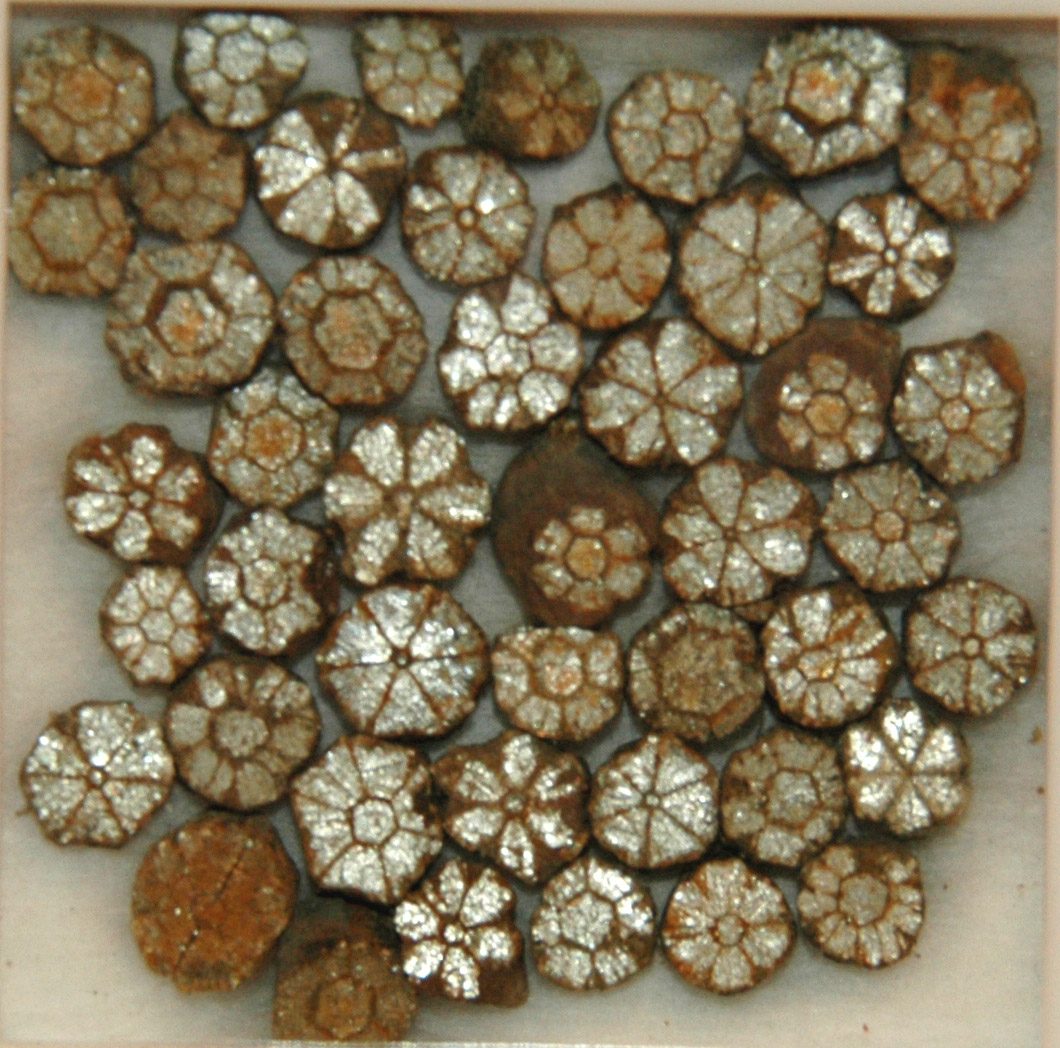
“Cherry blossom stones” - pinite (= muscovite mica replacing intergrown cordierite-indialite) from Kameoka, west of Kyoto, Kyoto Prefecture, southwestern Honshu Island, southern Japan. (Limper Geology Museum specimens, Miami University, Oxford, Ohio, USA) One of the most famous & visually intriguing geologic materials collected in Japan is the cherry blossom stone. These interesting structures have a complex geologic history. What are they now? Cherry blossom stones are relatively small, subhexagonal-shaped masses of fine-grained muscovite mica that show a flower-like pattern in transverse cross-section. What did they used to be? The muscovite mica is not the original material making up these structures. Before the growth of muscovite mica, these were complex intergrowths of six cordierite crystals and one indialite crystal. So, cherry blossom stones represent muscovite mica replacing cordierite-indialite (muscovite pseudomorphs after cordierite-indialite). Such complex pseudomorphs have been referred to as pinite. What is the host rock? Cherry blossom stones are hosted in a matrix of hornfels, a fine-grained, contact metamorphic rock. Hornfels form by intense alteration (heating & chemical alteration) of shales by nearby lava or magma. How did they form? The hornfels host rocks were originally fine-grained siliciclastic sedimentary rocks (shales) of the Tamba Group (Triassic-Jurassic-lowermost Cretaceous). In the mid-Cretaceous (early Cenomanian Stage, ~98 m.y.), underground igneous activity resulted in granites and granodiorite intrusions altering the shales into hornfels by contact metamorphism. These hornfels had decent-sized masses of intergrown cordierite-indialite. Indialite is a magnesium aluminosilicate mineral (Mg2Al4Si5O18). Cordierite is an iron magnesium aluminosilicate mineral ((Fe,Mg)2Al4Si5O18). The subhexagonal-shaped masses of cordierite-indialite in the hornfels consist of seven individual crystals. At the center of each mass is a dumbbell-shaped indialite crystal - very narrow at the center, and relatively wide at the ends (look at the varying sizes of the center hexagon in the cherry blossom stones shown above). Surrounding the indialite crystal are six prism-shaped cordierite crystals. They are widest at the center of each cherry blossom stone and narrowest at the ends. A second metamorphic event altered the cordierite-indialite masses. Hydrothermal metamorphism resulted in fine-grained muscovite mica replacing the original minerals. Much info. from: Rakovan et al. (2006) - Sakura Ishi (cherry blossom stones): mica pseudomorphs of complex cordierite-indialite intergrowths from Kameoka, Kyoto Prefecture, Japan. in Minerals from Japan. Rocks & Minerals Reprint 2006: 31-39. — Photo: James St. John · CC BY 2.0
Indialite
Indialite is an IMA-recognized mineral species in the silicate class, with the chemical formula Mg₂Al₃(AlSi₅)O₁₈.
It crystallizes in the hexagonal crystal system (space group P6/mcc). It is a member of the Beryl structural group.
Key properties: Mohs hardness 7–7.5; specific gravity 2.512; Vitreous luster; optically uniaxial.
IMA symbol Ind, grandfathered status — known before the IMA’s founding, named in 1954.
Formed by fusion and recrystallization of sedimentary rocks as a result of the burning of underlying coal seams (Bokaro coalfield, India); in cordierite veins in a polymetamorphosed pelitic rock (Unazuki, Japan).
It is found associated with Enstatite, magnetite, labradorite, corundum, glass (Bokaro coalfield, India); cordierite, andalusite, sillimanite, biotite, quartz (Unazuki, Japan).
The name refers to the country of first occurrence, India.